Tuesday, January 19, 2016

Something's Missing in the Arctic

“Arctic Sea Ice Hits Lowest Winter Maximum on Record”
        Written By Laura Smith Spark, CNN
       May 14, 2015
        http://www.cnn.com/2015/03/21/world/arctic-sea-ice/index.html (image and video from article)

      Last winter, New England was hit with a harsh, cold winter. However, the Arctic has had the opposite problem. The year of 2015 marked the lowest maximum ice coverage up north since NASA began recording the movement of ice caps three decades ago. Using satellites, NASA found that a total of 5.61 million square miles of ice in the Arctic was achieved on February 25. This seems like a lot, but it is 50,000 miles short of the previous low. Also, February 25 is 15 days  before the average yearly maximum. All these sudden changes have been taking tolls on the local ecosystem and food chain in the Arctic. Polar bears, who rely on the ice to hunt for seals, are being pulled away from not only food, but cubs too. Many other species are also in danger, such as birds and walruses. If the Arctic ice continues, it could change weather patterns, because of the Arctic’s large role in reflecting sunlight. Fortunately, the article noted that the warm northern winter did not necessarily mean a warm summer. "The winter maximum gives you a head start, but the minimum is so much more dependent on what happens in the summer that it seems to wash out anything that happens in the winter,” said Walt Meir, a se ice scientist at NASA. In conclusion, this article was focused on a particularly back year for the Arctic ice, and how that may be effecting inhabitants. 
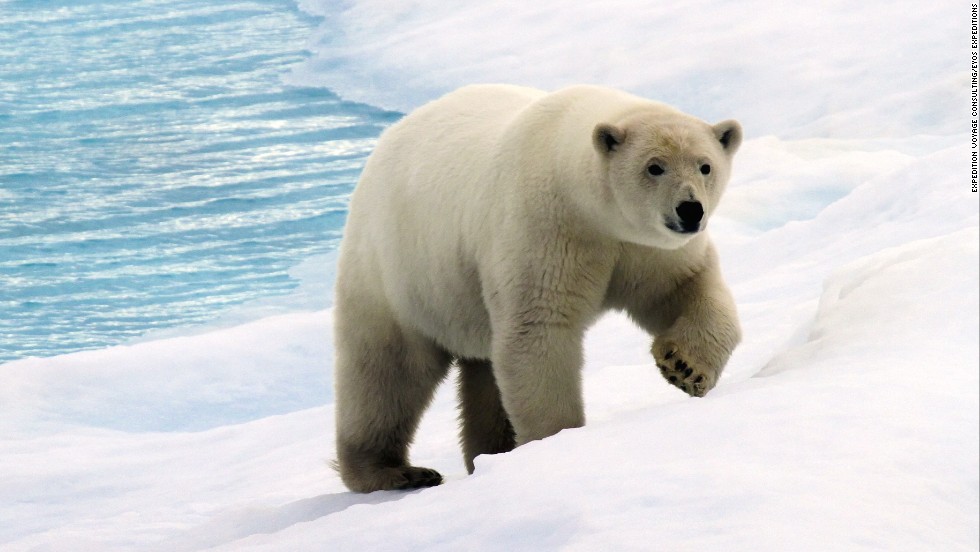
Arctic sea ice is a vital habitat for the polar bear. Photo: Expedition Voyage Consulting/EYOS Expeditions
A polar bear trudging across the ice. They are one of many species
endangered by the melting of the Arctic.
    
       When I reflect on this article, I realize that the science behind it is similar to what we have learned in class so far. For example, earlier this year we studied food chains and ecosystems, and how if a top predator is eliminated, it can trigger a “trophic cascade”. Because of the worsening situation of the melting ice caps in the Arctic, polar bears are being malnourished, possibly effecting their population. This means seals would be able to flourish without a large predator, eating away at the fish. As you can see, the Arctic food chain is very similar to ones we studied because of it’s delicate balance. This topic could also benefit society by contributing to scientists more about how the world works. From monitoring the ice movement and finding patterns, we might be able to figure out when major events (ice ages) happen in the weather. I found this article by looking on the CNN website, and this really stood out to me because I know the ice caps are a problem. After reading it, I agree with the author and the included video that something needs to be changed in order to fix it. However, I also wonder if this is normal for the Earth to experience, and the global warming we believe the culprit is not doing as much as predicted. From this article, I learned that the Arctic ice melting would not only effect the ecosystem, but the weather around us too, because the Arctic acts like a “big hat”. I also did not know that NASA is not only exploring other planets from above but also Earth. I think that’s really neat! Lastly, after reading this article, I wonder what is happening to the Antarctic ice. Is the reverse going on? Or is it also melting, at a slower or faster pace? In conclusion, this article was very fun for me to read and brought awareness to a small but growing problem.  "If the summer is cool, the melt rate will slow down. And the opposite is true, too: even if you start from a fairly high point, warm summer conditions make ice melt fast." - Walt Meier, NASA Space Flight Center, Goddard

Patrick.

Pig-Snouted Turtle Species Found!


Meet Golden’s bacon turtle, an extinct species with a pig snout 
Written By: Emanuella Grinberg and Christi Scott
6:33 PM ET, Saturday October 24, 2015 (When article was made)
Edited By: Camden Rollins


Meet Golden’s bacon turtle, an extinct species with a pig snout

     Can you think of the most interesting and funny looking animal to exist? Well, that animal has just been found in one of the most unlikeliest of places, The Grand Staircase-Escalante monument in Utah! The Golden’s Bacon Turtle or Arvinachelys goldeni, had been lost somewhere in the world for over 76 million years. This is a turtle that was surviving during the dinosaur era. This turtle had two nose holes smashed in so it looked like a pig snout. Turtles today usually have one nose hole opening. This was a very important find because any extinct turtles that have been found have only been a piece of a turtle. This fossil of the Golden Bacon, was in tact with a head, shell, hind-limbs, forelimbs, neck bones and tail. This is important because, "With only isolated skulls or shells, we are unable to fully understand how different species of fossil turtles are related, and what roles they played in their ecosystems," said Randall Irmis, curator of paleontology at the museum and associate professor at the University of Utah. 
A picture of what scientist think the Golden's bacon turtle
looked like.
     A group of scientists from National Geographic were enjoying a nice October day in 2015, when they stumbled upon a fossil which they almost mistook for a rock. “It is one of the weirdest  animals that has ever lived,” says Joshua Lively, a National Geographic scientist that stumbled upon this 76 million year fossil. Maybe your thinking, why would these turtle species be in Utah? Why wouldn’t they be somewhere more wet like Florida? This location confused the scientists and they quickly turned to a map to help them better understand. After looking at Utah on the map and working with a turtle expert, they still could not understand how this would be. Until, the group remembered that 76 million years ago, the world did not look like it does today. In fact, the scientist had to pull out a different map of the world, the Pangaea map. The scientists then realized that Utah, during the Pangaea period, was similar to a present day Louisiana, with wet areas and habitats supporting a mass population of turtles.
Fossil of the Golden's Bacon Turtle
      I think this discovery will further impact the way scientists think about turtles and be a key research item into the study of these animals. After concluding this pig-nosed turtle species was an extinct animal and that they no longer exist on earth, scientists will want to pursue more research of this turtle type. Just as we took flowers apart to study the pieces and better understand a flower, the scientists are taking apart all the Golden’s Bacon turtle’s parts to study this rare fossil. They are able to do this research because this rare find was found with all the pieces together. Perhaps a different disease existed a long time ago that is now unknown. It is one more piece to understanding the dinosaur era and maybe it will help scientists to understand how the 
dinosaurs died out for certain. It has already helped to confirm again the Pangaea theory.
Just as we took flowers apart to study the pieces and better understand a flower, the scientists are taking apart all the Golden’s Bacon turtles parts to study this rare fossil. 
     I chose this article because I love to learn about different animals but when I saw the picture of the Golden Bacon turtle, I started laughing and it caught my attention. The title was interesting but what really caught me was at the end of the title when it said,” with a pig snout.” I laughed. A turtle with a pig snout? I quickly clicked on the sight to see the picture. I found this article on CNN when my teacher suggested the sight for further reading and research.


-Camden

Football's Dangers, Illustrated by One Young Man's Brain


Football's dangers, illustrated by one young man's brain
By Nadia Kounang, CNN
Updated 11:18 AM ET, Mon January 11, 2016


http://www.cnn.com/2015/09/18/health/high-school-football-injuries/index.html
Head first runs are common in football.
         Michael Keck is proof of the dangers that come with playing football. Michael started playing football at age six and had ten concussions by the time he was 16. He never received treatment for a head injury. In high school,  Michael was a star student and decided to go to Missouri State college. In his freshman year while playing football, Micheal was knocked out and suffered another concussion. Unlike previous concussions, Micheal had head and neck pain, insomnia, and amnesia. He was allowed to play within three days of his injury but his symptoms never went away. In the beginning of his sophomore year, Michael stopped playing football. Micheal, once a star student, dropped out of college in his junior year and became depressed and suicidal. Michaels wife said that sometimes he would get so angry he would punch a hole through their wall. Michael believed he had chronic traumatic encephalopathy (CTE) which is not diagnosable in living people. CTE is an Alzheimer's like disease. It affects many pro and amateur football players. CTE is caused by many hits to the head. Michael died of Cardiac arrest in 2013. After he died, it was confirmed that he had CTE. Doctors don't think that his cardiac arrest and CTE were related. CTE is found in 44 of 55 football players but doctors and scientists still know very little about CTE. What we do know is that we should minimalize head contact in young players. Some experts even say that children under the age of 14 shouldn’t be allowed to play football at all.
http://guardianlv.com/wp-content/uploads/2014/02/hit_4.jpg
Defensive players often lead with their heads when tackling a ball carrier.
       While reading this article, I was very intrigued. I thought it was interesting that even though we know that a lot of football players get CTE, tons of people still want to play. I guess if you love to play, you don’t care about the risks. I also found it interesting how little we know about CTE. We don’t know exactly what causes it or the exact symptoms. All we know is that it’s bad. I was intrigued by the fact that he died of cardiac arrest. I wonder if this has anything to do with CTE. If CTE caused cardiac arrest, it would get a lot more attention. This would cause people to be much more careful. I really liked the article but I also had some critiques.  I liked that she showed how big a difference CTE made by saying Michaels GPA. She says, "He had a 3.8 GPA and was offered football scholarships to Alabama, Michigan and Southern California." Later in the article she says, "Keck was also suffering at school, the once star student now had a 1.9 GPA." This made it very clear how much CTE affects its victims. One thing I didn't like is how she explained what CTE is. She says, "The telltale sign of the disease is tangles of the protein tau, which takes over parts of the brain." This confused me a lot. I have no idea what protein tau is. If she had explained protein tau, I would known exactly what CTE was. Even though I had a few problems with the article, I learned a lot and had fun reading it.
Title of Article: Monkeys Steer Wheelchairs with their Brains, Raising hope for paralyzed people
Author:  Dan Vergano
Date Article Written: WED NOV 19 03:10:00 EST 2014


On Monday October 18, 2015 at the International Society for Neuroscience meeting in Washington DC, Duke University researcher, Miguel Nicolis PHD, presented his work demonstrating 2 rhesus monkeys who were trained to move a wheelchair using only their thoughts. He and fellow researchers implanted electrodes into the motor cortex of the monkeys’ brains. They developed a brain-machine interface that allowed those electrical impulses to drive the machines in the wheelchair. They trained the monkey to use the wheelchairs by providing positive rewards, grapes. Similarly, John Donoghue at Brown University implanted electrodes into the brains of human patients that allowed them to operate prostheses with their minds to drink coffee and to pick up objects. (No grapes were required to motivate the humans.)

I thought this article was interesting because my dad works with people everyday that could benefit from this research. He even got to meet a ex marine whose whole arm is robotic and controlled by his mind. I found the article on one of the websites on the science blog. This research combines technology with medicine to directly improve the lives of patients with spinal cord injury and/or amputation. Spinal cord injuries alone paralyze 130,000 people annually worldwide. Time and money are the two greatest limitations to making this research translate into reality for millions of affected patients. I checked the validity of this information by looking at the press release/media website for the Society for Neuroscience and finding the article.
Exoskeleton: Mango, a rhesus macaque, wears a pneumatically-powered exoskeleton which is able to move his legs in stepping patterns similar to those in bipedal locomotion. The exoskeleton can perform pre-programmed movements, and also can be controlled by the monkey's brain activity.
Monkey using exoskeleton to walk


Three bugs that have been Preserved for millions of years


Live Science
Article written by Laura Geggle
Published on January 8th 2016 
In my article they discovered bugs that were believed to be alive around 65.5-95.5 million years ago.  The bugs were found in a sticky glob of amber that perfectly preserved the mosquito like bugs. Two out of the three of them are new to mankind. Some Archaeologist (I think these were the type of scientist that found these bugs) found these bugs in Myanmar, Spain. An Archaeologist is a scientist who studies bones.  Xavier Delclòs was the first person to write about these findings.
This news is very important because these creatures could lead to more discoveries about the mysterious past
“During the age of the dinosaurs, three tiny mantises became engulfed in glops of sticky amber and stayed there, preserved, until researchers discovered the entombed critters millions of years later.”

Over all these bugs have stood the test of time and survived for 65.5 to 95.5 million years and will help us on how these bugs have changed over the time that has passed. These three bugs are part of a dozen species that have been found from that time period.  Mantis in amber

Pain Produces Memory Gain

Written By:  Laura Sanders
January 11, 2016
People remember many traumatic experiences in their lifetime.  Neuroscientists G. Elliott Wimmer and Christian Büchel may have found an answer to why this happens.  Wimmer and Büchel selected 31 people who were ok with feeling pain transferred from a heat-delivering thermode on their left forearms.  The neuroscientists ran a series of tests on these 31 people.  They were asked to look at several regular household objects whether feeling pain or not feeling pain.  Immediately after seeing the objects people were asked to take a pop quiz where they would say whether an object was familiar or not.  Regardless of whether pain was present, people remembered about ¾ of the objects shown to them.  A year later the same people were asked to take the pop quiz again and they were asked to say if the object was familiar.  People that received more pain than other people, remembered the object’s way better than the people who didn’t receive as much pain.  The results suggest that pain “somehow amplifies or stamps in the memories so that they are stored more robustly,” says neuroscientist Ben Seymour of the University of Cambridge in England.  Even though this is a huge breakthrough, this is the first step to discovering more about neurology.
This article grabbed my attention while I was scrolling through the list on Science News.  I had looked at many other websites and I didn’t really see anything that caught my eye.  When I clicked on the article I scanned the first few lines.  I saw a quote that really made me want to read this article. “The results are fun, they are interesting and they are provocative,” says neuroscientist A. Vania Apkarian of Northwestern University in Chicago. The findings “speak to the idea that pain really engages memory.”  After I read this I wanted to know why the results were fun  and interesting.  I agree with Laura Sanders because it makes so much sense when you are finished reading the article.  It connects to lifetime experiences that either you or somebody you know has been through.  You are able to recall the worst moments.  This connects to what we are studying because we are going to start learning about cells and DNA.  Even though this isn’t totally involved with cells, it has to do with Neurology and the nervous season.  After reading this article I started to wonder if this happens to everybody or just some people.  I think scientists have a lot more to discover in this field of science.
pain in arm
Bibliography for picture and article

The Mystery of Why Snakes Shed Their Legs is Finally Solved

The Mystery of Why Snakes Shed Their Legs is Finally Solved
Kim Bussing
12/11/15
Most people would think that snakes have always “slithered” around. Actually, that wasn’t always the case. David Martill, a paleobiologist at The University Of Portsmouth, was taking his students on a field trip at Germany's Museum Solnhofen in July, 2015 where he came across an old fossil of a snake with legs. He was able to find that the fossil was 20 cm long and had legs, wrists, elbows, and hands. After several studies, he found that the snake had no adaptations to live in water after looking more carefully at the skull. That gave him and many more scientists the idea that snakes had evolved on land. Many others thought that wasn’t accurate information, because they thought that the snake was actually a lizard. Then, a group of American and Scottish scientists conducted a study. They were able to find out that the reason snakes don’t have legs anymore was because it was easier for them to go without legs to hunt. They could go underground much easier to catch their prey. The discovery made to prove snakes had legs is a very important one. It can help other scientists learn more about the history of snakes, and maybe even more. The team was able to discover this from a new CT scan, by comparing a 90 million year old reptile skull that was similar to a modern day snake. They posted their evidence online, and were able to prove why they thought snakes had evolved on land.
This article connects to what we are studying in class because we do many experiments. Just like the scientists, we learn new things and are able to collect data. I thought this article was very interesting, mainly because I never knew snakes had ever even had legs. The reason I chose it was because I thought it would be a very interesting article to share about in class and I also thought that the article was very fun to read about. I learned a lot about this particular subject, and think it’s a great subject to learn about. Even though some people don’t agree with this article, it really shows you what has been done to prove snakes have evolved on land. I think this is affecting scientists who study reptiles and amphibians because this evidence may help them learn more about snakes, and maybe even about other animals like snakes. After reading it, I did have a few questions about the topic. One question that I would like to learn more about is: If snakes evolved on land, how come there are snakes living in water? That question had me right away when I was convinced that snakes had evolved on land. One quote from the article that I thought described how snakes shed their legs was: “They believe that as the reptile's hearing sharpened and became accustomed to their subterranean habitat, its limbs began to recede, until they disappeared altogether.”  That shows an idea of how/why snakes shed their legs. Overall, I think that this article is very important and will help many scientists all over the world with new types of studies and ideas.
This is showing a picture of the snake fossil with legs
Video: