“Arctic Sea Ice Hits Lowest Winter Maximum on Record”
Written By Laura Smith Spark, CNN
May 14, 2015
http://www.cnn.com/2015/03/21/world/arctic-sea-ice/index.html (image and video from article)
Last winter, New England was hit with a harsh, cold winter. However, the Arctic has had the opposite problem. The year of 2015 marked the lowest maximum ice coverage up north since NASA began recording the movement of ice caps three decades ago. Using satellites, NASA found that a total of 5.61 million square miles of ice in the Arctic was achieved on February 25. This seems like a lot, but it is 50,000 miles short of the previous low. Also, February 25 is 15 days before the average yearly maximum. All these sudden changes have been taking tolls on the local ecosystem and food chain in the Arctic. Polar bears, who rely on the ice to hunt for seals, are being pulled away from not only food, but cubs too. Many other species are also in danger, such as birds and walruses. If the Arctic ice continues, it could change weather patterns, because of the Arctic’s large role in reflecting sunlight. Fortunately, the article noted that the warm northern winter did not necessarily mean a warm summer. "The winter maximum gives you a head start, but the minimum is so much more dependent on what happens in the summer that it seems to wash out anything that happens in the winter,” said Walt Meir, a se ice scientist at NASA. In conclusion, this article was focused on a particularly back year for the Arctic ice, and how that may be effecting inhabitants.
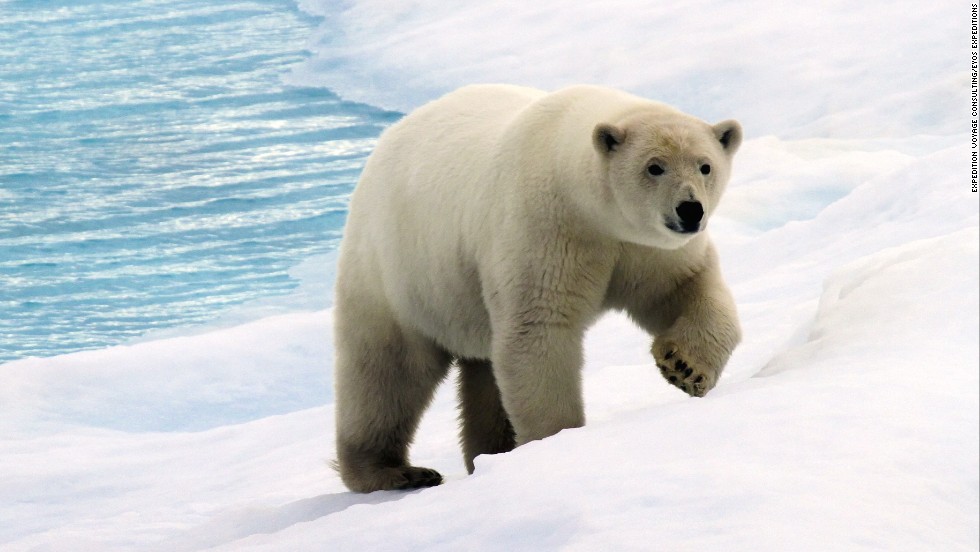 |
| A polar bear trudging across the ice. They are one of many species endangered by the melting of the Arctic. |
When I reflect on this article, I realize that the science behind it is similar to what we have learned in class so far. For example, earlier this year we studied food chains and ecosystems, and how if a top predator is eliminated, it can trigger a “trophic cascade”. Because of the worsening situation of the melting ice caps in the Arctic, polar bears are being malnourished, possibly effecting their population. This means seals would be able to flourish without a large predator, eating away at the fish. As you can see, the Arctic food chain is very similar to ones we studied because of it’s delicate balance. This topic could also benefit society by contributing to scientists more about how the world works. From monitoring the ice movement and finding patterns, we might be able to figure out when major events (ice ages) happen in the weather. I found this article by looking on the CNN website, and this really stood out to me because I know the ice caps are a problem. After reading it, I agree with the author and the included video that something needs to be changed in order to fix it. However, I also wonder if this is normal for the Earth to experience, and the global warming we believe the culprit is not doing as much as predicted. From this article, I learned that the Arctic ice melting would not only effect the ecosystem, but the weather around us too, because the Arctic acts like a “big hat”. I also did not know that NASA is not only exploring other planets from above but also Earth. I think that’s really neat! Lastly, after reading this article, I wonder what is happening to the Antarctic ice. Is the reverse going on? Or is it also melting, at a slower or faster pace? In conclusion, this article was very fun for me to read and brought awareness to a small but growing problem. "If the summer is cool, the melt rate will slow down. And the opposite is true, too: even if you start from a fairly high point, warm summer conditions make ice melt fast." - Walt Meier, NASA Space Flight Center, Goddard
Patrick.

The video adds extra information. I now know more about polar bears and endangered species in the arctic.
ReplyDeleteI love how you included the video. Like Lizzie, I think it adds some good extra information. Is there a prediction of what will happen to the Arctic in the next few years? A connection I have to this is that my dad lived in Alaska for seven years, and he is also really passionate about this. I think that what can happen is that people hear about global warming so much that they think that other people will take care of it, so they don't have to do anything. That is a similarity with my article too, I am afraid that people won't take global warming that seriously. This article will definitely help people understand the danger the Arctic is in.
ReplyDeleteI am angry. This is how we treat our home. We start to destroy it. We started out not knowing, we know now, we try, I hope, to stop it, but we can't. How did this all start? We are killing polar bears and, by extension, seals, fish, and all sorts of others. When I was little (and kind of now too) I was fascinated by seals, but especially harp seals. A great deal of them live on that ice, and I would be sad to see them go.
ReplyDeleteActually no. I am not really angry. I'm just disappointed, and sad.
P.S. You did a great job on your summary!
You did great job writing about the problem in the Arctic.You also did a great job summarizing the article that you read. The video you added was a great idea! Keep up the good work
ReplyDeletePatrick,
ReplyDeleteYou had a great connection to the trophic cascades that we have studied before! It was a perfect connection to science and society, less fish for us, too many seals, and affects to the polar bears population. You did a great job on the summary, but I wondered what you thought the pros and cons were for this article and knowledge we gained from it.