Thursday, January 28, 2016

Current Events Project

I have done research on an article about part of a human skull that that was found in the Afar region of Ethiopia. This human was named Australopithecus Deyiremeda. CNN said  “the name, Australopithecus deyiremeda, derives from the local Afar language and means "close relative" -- referring, the researchers say, to "the species being a close relative of all later hominins." This human was estimated to be living about 3.5 million years ago which could be compared with the human bones found in the 1970’s that was named Lucy by the people. The leading researcher in the project, Yohannes Haile-Sellasie used the term “Hominin” that means hominids that includes “recent humans together with extinct ancestral and related forms.” The quote coming from the researchers is "Current fossil evidence from the Woranso-Mille study area clearly shows that there were at least two, if not three, early human species living at the same time and in close geographic proximity."

Overall, this is a great discovery has lots of pros for the human race, we can find our origins, solve mysteries of the past or even use that dna! I think that this is not “earth shaking” like some other topics but it is still very interesting to see how we have evolved over the years. The reason I chose this project was because I was very interested in the early human that was found in the 70’s, name “Lucy.” I do not think that this even remotely as important as the discovery of Lucy because only parts of the jaw and head were found, as opposed to the whole body of Lucy. I think that scientists should keep searching for more bones in Ethiopia because that is where lucy and these other bones have been found in Ethiopia. Overall, I think that there will be nothing but good things to say about this amazing discovery.


May 28, 2015

Monday, January 25, 2016

DNA

Odin              DNA
1/19/16


I read and found an article about DNA (Deoxyribonucleic Acid) DNA is a the assortment of cells in the body and the physical traits of the human being, this article was made by Eric D. Green, M.D., Ph.D. It is used to help us classify human being, understand the human body and sometimes even in solving crimes that we humans have committed. It was created by Friedrich Miescher in 1869 at the University of Tübingen which changed the way we identify humans to be different. He didn't have a reason to find this but if he did I almost guarantee it would be to help out and find out what diseases are in people. It also could help solve the amount of crimes and mistakes people were making back then. For instance buried alive, because remember science wasn’t the same back then they sometimes couldn’t tell the difference from sleeping and dead was. But that is what I assume his question or reason would be to find this discovery.


I chose to read this article because I always wondered how DNA worked and how they processed it. DNA is a very complicated thing and I never really understood it until now. I just knew that it was something we had and tells who we are. I was looking just for websites under DNA and I found this and I realized this was one of hundreds of articles. I agree on what the author thinks of DNA and I love how he explains it, although he is not to serious about it all through the article. Since we are studying plants and cells of monocots and dicots there are a lot of similar things like both of them have a nucleus, and both of them have cells that control them. Although I wonder how they found it and what technology they used to see it as well as what type of DNA it is.
It was very reliable and it had just about everything I needed to make a great response. Plus it doesn’t just have an article on DNA it has another one on the genome and other things about the human body. All in all it had reliable resource and it expressed it very clearly. One thing I wondered was also if you know how to find DNA maybe through that you can figure out how to change it. When I look at plant and notice there is a thing called a perfect flower, I wonder if it is possible that the same can be said with any living thing. I wanted to look into this because I always thought scientist that dealt with the human body was cool and I was always very intrigued.


Pompeii Victims' Bodies Revealed in Scans

Written By Rossella Lorenzi
Discovery News

About 2,000 years ago Mount.Vesuvius erupted killing about 2,000 people in Pompeii. Pompeii was hidden under 8-9 feet of ash. Giuseppe Fiorelli and his team found that the bodies were covered in layers of ash and pumice, so they filled the hollow bodies with plaster making a plaster casts of the bodies they found. Stabia and Herculaneum started CT scanning the plaster casts of the 86 bodies created by Fiorelli. Of all the bodies, they found a boy who was about 4 years old. He was next to two adults(Male and Female) who were most likely his parents, also there was a baby on his mother's lap  CT scans could tell what his clothing was that he was wearing and specific spots of his skeleton. Many people died from head injuries because they were trying to escape but debris from buildings falling over. Humans in the town of Pompeii had about perfect teeth. Some had cavities but most of them were excellent. They also ate a lot of vegetables and fruit and almost no sugar. Fiorelli’s scanned about 30 men, woman, a boar and a dog.   

I chose this article because I have always been interested in Volcanoes and I found the news very interesting. This article affects me by how many people died in Pompeii. When I was reading this article it was really cool how the scientists could find if they had any issues with their bodies like head injuries or any tooth issues. They could also know what they ate. All with just a CT scan. This article made me think of what scientists can do with other massive volcanoes maybe ones bigger than Pompeii.Another thing I thought was cool about this article was that the scientists could scan a wild boar and a dog.In conclusion, This article was very interesting and learning packed.

Friday, January 22, 2016

Red meat Cancer study

Back off the bacon and cold cuts


By Stephen Ornes
January 8, 2016

The World Health Organization recently determined after countless studies that consuming too much red meat leads to a more likely chance to cancer. “You shouldn't be eating well-done cooked meats, or barbecued chickens, or barbecued steaks, or processed meats every single day,” says Robert Turesky. Robert Turesky is a food scientist at the University of Minnesota. Studies have shown that the hazardous chemicals once in the body can cause diseases  such as cancer, “too much of anything is unhealthy” He warns.  


This article is important because every year, 130,000 people are diagnosed with Colorectal cancer almost half will die. If you eat 50 grams or more of red meat/ processed meats each day, then you have a great chance of being diagnosed with Colorectal cancer. Colorectal cancer starts in the Colon or Rectum and cells grow into tumors. Cancerous  cells may enter the bloodstream, travel to
other places in your body and grow new tumors.

I Eat a lot of meat and I heard that a lot of meat was bad for you but I never really knew that it was this bad. I was shocked and it makes sense that processed meat can cause cancer. My opinion is that if people want to eat a lot of red processed meat that's fine as long as they know that risks. The risks are there and they are high but nobody can just stop meat production. I believe that everyone should know the risks and they can take them if they want..


meat case


Thursday, January 21, 2016

"Racing Extinction"

  Link to Article
'Racing Extinction': Documentary Explores Global Loss of Wildlife
Publication Date: Nov 30 2015, 4:50 PM
by Munir Atalla, Cynthia Mcfadden, and Jake Whitman


My article is about the extinction of species all over the world and how humans are not trying hard enough to stop this mass extinction, and how we could in a number of ways. The article is based on the documentary that came out in early December 2015.  The documentary was made to bring the focus to the fact that this is actually the only mass extinction caused by one specific species, humans. But it’s main point was to form a person connection between viewer and animal, for example I took notice to the story about manta rays that are being hunted off the coast Indonesia. The manta rays are being hunted for one reason and one reason only, for their gills. There gills are used in ancient chinese medicine. But think about it, these poor animals have never done a thing to these hunters and they are being killed for only one resource. They are wasting an entire manta ray just for their gills, in fact there meat is not is not even tasty. It’s something that really made me want to somehow change the state that these manta rays are in.
I honestly don’t think there are any cons to this article. It shines a light on a topic that certainly is forgotten.   People always think “oh that’s someone else's problem.” Just like as it’s said in the documentary.
One thing that really surprised me in the documentary was one quote that Louie Phishoyos said “The biggest mass extinction since the dinosaurs” and that really shocked me because to think that we are living in a time where our planet may be going through something that could possibly be killing it. And most of us are just sitting back and letting it happen. It also pointed out that there are people all around the world trying to preserve these species and could possibly be putting their lives in  danger for these animals.
Overall I would recommend not only this article but also further knowledge of the issue it is discussing. It’s something that I think everyone should learn about considering the circumstances our planet is in. After all the extinction of these beloved animals.

Tuesday, January 19, 2016

Australian Researchers Hope to Find the Reason of Honeybee Decline


Title: Australian researchers combat bee decline with tiny trackers
Written By: Michael Pearson
Published: Tue August 25, 2015, CNN

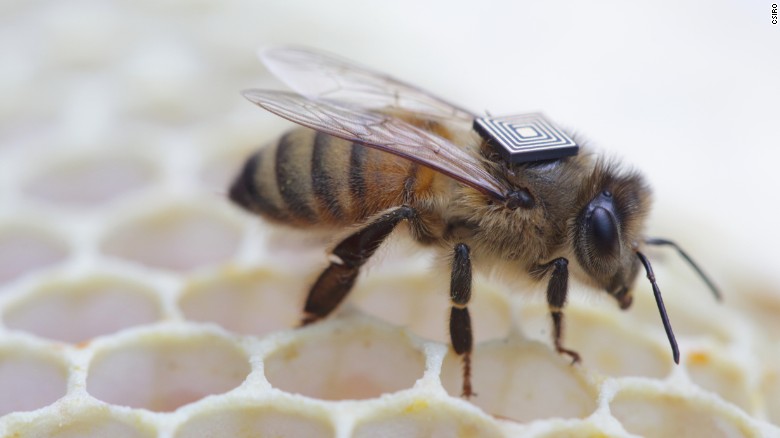
Data has shown the decrease in numbers of the honeybee population over various time periods, but very few people are doing anything about it.  After all, why would they? To many people, a honey bee is just a small insect that can sting. What many people don’t realize, is that honey bees are responsible for providing pollination of  one third of the foods we eat. With the number of bees decreasing, it gets harder and harder to pollinate both crops and flowers. From April 2014 to April 2015 alone, U.S. beekeepers have lost a total of 42.1% of their colonies. Why? That is what many people across the globe are trying to figure out. There have been different attempts to increase the bee population, though so far, they haven’t worked. Australian researchers’ newest idea is something called the “bee backpack”. The “bee backpack” is a tiny micro-sensor that is able to track the location of the bee to which it is secured. It is tested by the Commonwealth Scientific and Industrial Research Organization of Australia, where the bee population is not in decline. The hopes for this experiment is to be able to see how the bee’s environment affects their movement. By following their movement, researchers can understand the bee’s stress factors.
The information gathered in this experiment is important, as it can save lives of many bees, make a breakthrough in the technology world, and affect much of our food supply. Though there are many strengths to this technology, it has its limits. As it can only detect location and movement, there is only hope that scientists can analyze what in a particular environment is causing the bee stress. The micro-sensor can fail, or fall off of the bee’s backs, as the only thing securing it is glue. The data collected from a certain bee might not reflect the behavior of all bees. After reading this article, it made me wonder if, in the future, people will install technology inside the bee that can detect pulse as well as location, so scientists can be sure of how bees are responding. Is there a less labor-intensive way to place the micro-sensors on the bees, so that more bees can be tracked. If the technology is able to gather enough information for scientists to analyze, it could save many bees lives. It is a problem, not only that bees are decreasing, but also that the reason of the decline is unknown.
There are many ways that saving the bee population connects to what we have been studying in class. We have learned about the plant life cycle, and how plants are pollinated, and that for a plant to reproduce, it needs to be pollinated. There are many ways a plant can be pollinated, but one of the most common ways is by pollinators, such as a bee. Without bees, the pollination of a plant relays on wind, water, people, or other animals, which are a more uncommon form of pollination. This article also relates to the technology world, and how to track different objects using micro technology. The way of tracking different objects is used in many ways today, such as theft-prevention, data collection, and GPS.
“The tiny technology allows researchers to analyze the effects of stress factors including disease, pesticides, air pollution, water contamination, diet and extreme weather on the movements of bees and their ability to pollinate,” The organization’s science leader, Paulo De Souza, summarizes the main hopes for the project.  The quote shows how scientists are analyzing the technology’s data. I think this quote also shows the basic premise of the experiment, and what types of problems scientists think limit the bees.
I chose this article because I wanted to learn more about honeybees, and what people are doing to prevent their decrease in population. I also wanted to learn more about technology, so it is interesting to see the different ways using new technology can help the honeybees. If people can fit a tracker into something less than a ½ of centimeter cube, it shows what else people can do with technology.
Image result for Australian researchers combat bee decline with tiny trackers
The "bee backpack" used to track Honeybee's location
http://i2.cdn.turner.com/cnnnext/dam/assets/150825161121-honey-bee-backpack-exlarge-169.jpg

Chimps know when they've nailed a test, studies say

By Ben Brumfield, CNN
Updated 9:54 AM ET, Wed June 10, 2015


According to researchers of universities in Georgia, South Carolina and New York, Chimpanzees know when they get a question right. These Monkeys have almost the same level of metacognition that us humans do. Metacognition is when you know that you know something. Researchers found this in a few tests they provided the Chimps with in June 2015. They put computerized memory chips in their heads and when they got the answers right, they were rewarded with food. When the answer was correct, the food appeared out of the test area. The Chimps were alerted by a sound that was a little delayed. If the Chimps didn’t get to the food fast enough, it would be thrown away. Therefore they had to predict if they got the answer right to arrive at the food station before the food was available. The Chimps predicted it almost every time therefore showing that they have almost the same level of metacognition as us. Researchers could use this information to get us closer to communicating to Chimps. It can be helpful to understand more about the evolution of humans and what we used to be like. Now that we know that, people may be more considerate and more willing to make donations to help Chimps and other monkeys out in the wild who need help.
I chose this article because I found the news super interesting and I wanted to know more about how Chimps are related to us. This article doesn’t directly affect me but I suppose it affects everyone in some way because we evolved from apes.
I thought that this was very interesting to know and when I saw the heading of the article I immediately wanted to know more. As I started reading I came across this “It's more than just knowing something. metacognition is knowing that you know something. Like humans, chimps can think about their thinking and change their behavior as a result, the researchers believe.” I thought that this was really cool to know and I realized that Chimps might be even closer to us than I thought. I mean they’re animals and we are humans but they have quite a lot of intelligence. metacognition is quite deep and for an animal to have this is surprising. metacognition involves the physiology of animals. The fact that  Chimps are as smart as they are is great news for animal activist people because they can use this news to make people want to help monkeys more because they are so alike to us. It also gets us closer to communication with them, I believe. I don’t think there is really anything bad that will come from this news, which is great!
Works Cited
“Crows Can Count, and Chimps Know When They’ve Nailed a Test.” CNN. N.p., n.d. Web. 13 Jan. 2016. <http://www.cnn.com/2015/06/10/us/chimpanzee-crow-intelligence-studies/index.html>.

Should we eliminate suger from our diet

URL:http://www.medicalnewstoday.com/articles/288088.php


Author: By Honor Whiteman

Published:Medical News Today Pub 

Date:January 11, 2016


Have you ever wondered why parents cut sugar from diets well this is what this article is about. Sugar isn't the best thing in the world I know. But if you really think about it there is more to sugar than we think. There is a lot of things that sugar can do to our bodies. Sugar is one of those ingredients that has its pros and its cons.
Sugar (sadly) can cause a lot of diseases. For example High Blood pressure is one of the dangerous diseases caused by too much sugar. Another example is death from cardiovascular disease. Lastly it can cause obesity. Most of these diseases are caused from added sugars, not the sugars that are found naturally in food. Researchers think that sugar can be addicting. "Sugar is basically a socially acceptable, legal, recreational drug with deadly consequences."

But for all the cons not all sugar is bad for you. There are a lot of sugar in the food we eat every day like fruit, dairy, and vegetables. We eat sugar every single day. Men and women need almost the same calories from sugar everyday. Men: 150 calories per day (37.5 grams or 9 teaspoons). Women: 100 calories per day (25 grams or 6 teaspoons). It would be hard to quit eating all sugar because it is found naturally in the healthy foods we need. "Cutting all sugar from your diet would be very difficult to achieve. Fruits, vegetables, dairy products and dairy replacements, eggs, alcohol and nuts all contain sugar, which would leave you with little other than meat and fats to eat - definitely not very healthy."

I can connect to this article because my mom is so against sugar that she gets rid of it completely and I honestly think that isn’t the best idea.  It is not the best idea because you need sugar to be in your diet. Even though you cut sugar from your diet completely you need the foods that have sugar in them. When I don’t have sugar in my diet I feel very worn out and I don’t have the energy I need in the day. When friends come over, and I don’t have those cool foods it makes me feel like I’m not one of those cool houses that has like every fun food. "The key thing to remember is that sugars occur naturally in a wide range of foods - including fruit, vegetables and dairy products - and can be consumed within a healthy, balanced diet and active lifestyle. As always, balance and variety in a diet is the most important thing for people to remember."

When I first read this article I found a lot of things that sugar can do to the body that I did not know. I always thought that if you ate too much sugar you would just get fat, but there is way more to it. There is a lot more bad things or cons that sugar can do. I never really knew that sugar can cause death. I already knew some of the facts that they said in this article like for example sugar cause obesity and cancer. I did not know that vegetables contain healthy sugars. I thought it was just fruit, but apparently not. I think that we should not eliminate sugar from our diet because sugar is what we eat in fruits and vegetables which are healthy and if we eliminate those then we would only be able to eat meat. I think we should eat sugar, but not get too carried about with it. We should be careful not to eat too much added sugar and we should stick with eating natural sugars that are in fruits and vegetable.

Some Fish Wear an Invisibility Cloak

Science News For Students
Written by Ilima Loomis
                      

Current Event Project

The article I read was called “Some Fish Wear an Invisibility Cloak”. This article was about fish that blend into light patterns in the ocean and become “invisible” to predators. Why the fish can reflect polarized light is because with their platelets on their skin, when they are looked at at a 45 degree angle (which is called the chase angle for predators hunting fish) they can barely be seen. The platelets are very tiny and one hundred can fit inside a grain of sand. This article investigated fish, particular the Lookdown fish and the Bigeyed Scad which are fish that can reflect the polarized light. The scientists used a video polarimeter which is a machine to see light like fish do so that they could understand what fish had the ability to become “invisible”. The experiment took place off of the coast of California. The scientists are now thinking about investigating whether the predators of the invisible fish have a strong enough vision that they can deal with polarized light. The scientists conducting the experiment, really were impressed by the information they found about the “invisible” fish.

“Of the five species they studied, the two open-ocean fish had the best camouflage. One was the lookdown, a silver fish that swims in the Atlantic. The other was the bigeye scad, a tropical species that has a blue-green or green back and white belly. Platelets on these fish reflected polarized light. And it helped them blend into polarized light”
I chose this article because I was really intrigued by the title. I wanted to find out more about the fish who wear allegedly invisible. I’m also interested in marine sciences. I found the article on the Science News for Students website. I found it really interesting how the fish could reflect the ocean’s light and become almost invisible or camouflaged to their predators. I think the article connects to what we are studying because a fish is a living organism. The Lookdown and Bigeyed Scad fish have scales on their body which can reflect light and that is part of their anatomy. This new information is effecting our society because it gives us more knowledge on the ocean and its inhabitants. The ocean is the only real unexplored territory on Earth and any new information about it is always influential. One of the benefits of this new information is that it can give us insight on how fish live and survive. It can start new questions about marine biology. I wonder if the fish that have the ability to reflect the polarized light are very plentiful in population because they can avoid predators. Or are these fish very uncommon? These are some questions and inquiries that I thought of while reading this article. Another benefit is that the information found by this discovery can help the U.S. Navy find ways to hide and protect submarines and create new forms of ocean camouflage. Overall, the information I acquired in this article has really sparked my curiosity in this branch of Marine Biology.  


Bee Backpacks

Australian researchers combat bee decline with tiny trackers, By Michael Pearson, Tuesday August 25, 2015

Pusheen Yale
Due 1/19/2016


Bees are starting to go down in population. So Paulo de Souza had the idea to put little back packs that use radio-frequency identification to make logs of the effects of stress factors on the bees movement. The genius who came up with this idea was Paulo de Souza. Dr Paulo de Souza is leading research on micro-sensor technologies and systems. A physicist and miniaturisation expert, Dr de Souza is recognised internationally in field robotics geochemistry and environmental engineering Because we use bees for many things. We wouldn’t have fruits, vegetables, nuts or honey without bees. This is very important because bees make most of our food. "Beekeepers have lost 42.1% of their colonies between April 2014 and April 2015. Commercially managed colonies in the United States have declined from 6 million in 1947 to a little over 2.6 million in 2013, according to U.S. and U.N. statistics." Witch isn't such a good thing. Everyone will feel the impact of this news. Prices in fruits, vegetables, nuts or honey will go down if the bee population can go back up. Because if there are more bees they can pollinate faster. the researchers will be able to identify what is affectioning the bees.

I chose this article because it will affect the economy and will effect everyone in the world if the bee population keeps going down. All plants will die, then the live stalk will not be able to be eaten because they don't have anything to eat, then us humans will die out because of the lack of food. My personal reaction is a positive one. Money will go down on fruits, vegetables, nuts and honey if the bee population goes back up to the original population. If the researchers get the information they need by the bee beck packs. They can change the bees environment to their needs. By diction what the bees are stressing about.

Picture is from video on website

Scientists discover potential biomarker for migraine in the blood

9.10.15
written by: James McIntosh

Recently this year at the Johns Hopkins University School of Medicine in Baltimore, MD
a group of researchers including Dr. B. Lee Peterlin took in 52 women who get episodic migraines and 36 women who don’t. They measured the body mass and took samples of the women's blood. The researchers checked the blood and found that the people with migraines had a lower number of Ceramides. Ceramides are a group of lipids that help control inflammation in the brain. The women that did not get migraines had 10,500 nanograms per milliliter of Ceramides and women that got migraines only had 6,000 nanograms per milliliter of Ceramides. The scientists discovered that a higher amount of Ceramides decrease the risk of getting migraines. To test this they took 14 people's blood and tested it. The predicted if the people had migraines or not and there answers came out correct. This research could help anybody who who suffers from episodic migraines because this brings us closer to finding out more information about how to stop them and why they happen.
I chose this article because it relates to me and I am passionate about the topic of migraines. I always want to know what is happening to me when I’m getting a migraine and why it is happening to me. When I was told about this article I thought it was perfect because I could research something that really mattered to me for school and help myself at the same time. The article really helped me to understand a little bit of why I get migraines. Also I learned a lot of interesting information from the article to like around 1 in 4 American houses someone gets migraines also that The World health organization thinks that migraines are one of the world's 20 most disabling diseases. I think this topic relates to the units we have been studying because we have been talking about the difference between monocots and dicots differences and this is kind of like that in the way they are comparing people with migraines and people without migraines differences. I think that this will definitely help researchers and doctors find information on migraines and how to cure them since there is no real cure and this is a big piece of information.

elephants and poaching what will happen!


National geographic
Written By J.D. O’Kasick, for National Geographic
Published Thu Dec 10  18:37:16 EST 2015

“Signs of hope in East Africa include high-profile court cases, on-the-ground results, and a new president nicknamed the Bulldozer.”
What has been done about the elephants in 2014 & 2015 has varied a lot now in 2016 more elephants have been getting poached but more people have been stepping up to the fact about if they don't help with them most likely they could go extinct. You may ask how, in an article of national geographic it tells about poachers and fines for what they have to pay for and go through for committing this horrible crime. In this article it took place in November 2015. This event took place in Arusha High Court in northern Tanzania. Also it will affect the poachers and the elephants it will affect the elephants in a good way and the poachers in a bad way which is good, meaning by their wont be anymore poaching for the elephants. The people who took part in this article are the Wildlife Services officers,officials and conservation professionals, officials in Kenya,Tanzania’s President John Pombe Ma (and more). But as you can see this is a big problem going on. But  more people are realizing what's going on and are willing to help out I would assume.
This is very important news because in a couple of years if the poaching doesn't stop then that means elephants could go extinct that’s why it's important. This is useful information because we can know and tell how  and when this was happening or when it happened and when they might be trying to do something about it. I think it makes a huge difference because then we won't have to worry about the wonderful elephants going extinct. I choose this article because i think it's super important that we still have elephants on the planet, also because i tried writing a letter to the Pope in 2014 but he didn't really do anything about it at all.I think their was a need for this reach search because elephants need to still be respected like humans are to and like every other animal as well. I think this articles affects me because I'm very very connected to animals and i would never want one of them to get hurt so yes it would definitely affect me a lot and i think it would affect a lot of other people to. I think that they are starting to realize they need to do something about it finally so i feel like i have a good reaction but then bead because they say will it be in 2016 or not so i have mixed reaction about it. My pros are that they are realizing it now my con is that elephants are going instinct fast so they better do something about it. My pro is  well it’s good because then if they save them we will still have elephants. In the national geographic article about the elephants it tells you how many people are against the poaching of elephants. Some people even took part in the global march for elephants and rhinos that took place in  Nairobi.

2100 Prediction; Parts of Earth Will Be "Unlivable"

Places in the Middle East, the Persian Gulf Region, May Soon Become “Unlivable”
Link to article: http://www.cnn.com/2015/10/27/world/persian-gulf-heat-climate-change/index.html
Article title: Persian Gulf heat: It may become too hot for humans to survive, study warns
By: Brandon Miller, CNN Meteorologist
Source: Web; article
Publisher: CNN.com
Date published: Wednesday, October 28, 2015

The main idea/summary of the article, “Persian Gulf Heat: It may become too hot for humans to survive, study warns,” is that authors from Loyola Marymount University and Massachusetts Institute of Technology (MIT), discovered that by 2100, places in the Middle East, the Persian Gulf region, may be unfit for humans to live or be “unlivable.” So, the “who” of the article is the authors from Loyola Marymount University and the Massachusetts Institute of Technology (MIT), who discovered this horrific prediction and were involved, but also the people living in the Middle East, who are going to ultimately be affected. The “what” of the article is that in terms of what has been discovered, is that with a drastic change of climate, aided by global warming, places in the Middle East, the Persian Gulf region, and its major cities like Dubai and Abu Dhabi, can become unable for humans to survive and live there, or be “unlivable” by 2100. Although the “what,” “why” and “how” of the article, in terms of how this discovery was found, was that they, the authors, found the discovery by realizing that by 2100 places in the Middle East will be too blistering hot in the summer. They figured this out by taking note that while global temperatures become higher due to greenhouse gas emissions, areas in the Middle East would most likely be the first to reach the level where it would be unfit for humans to survive because it already very hot. However, they concluded that this wasn’t much of a problem due to a process called evaporative cooling. It’s when you react to heat by sweating, and then the sweat on your skin evaporates, cooling you off.
Although, that helps, but the scientists then realized that as the moisture and temperature increases, the process becomes less and less effective. Sometimes it even reaches a place where a body can no longer cool down. So, they realized that when evaporative cooling is no longer very effective, the heat of places in the Middle East was still a problem. Then, they clarified their discovery by looking at a value called “wet-bulb temperature.” It is a value that compounds air temperature and humidity together. The authors ran studies to see how this changed over time with increasing greenhouse gas concentrations. This allowed them to see how summertime conditions in individual cities, such as Abu Dhabi and Dubai, will change by 2100. They came up with a horrific prediction. Currently, the wet-bulb temperature only exceeds 31ºC (88ºF). It never gets to 35ºC (95ºF), a lethal temperature. Although, by 2100, many regions along the Persian Gulf, including Dubai, will see the wet-bulb temperature reach 31ºC on an average summer day. On some days the wet-bulb temperature could exceed the lethal state of 35ºC. Also, the “when” of the article is that the studies took place around approximately the date of publication, Wednesday, October 28, 2015, and the authors predict that places in the Middle east will be “unlivable” by 2100. The “where” of the article is that obviously in the location of the Middle East, areas will become “unlivable” for humans. So, the main idea/summary of the article is that is that authors from Loyola Marymount University and Massachusetts Institute of Technology (MIT), discovered that by 2100, places in the Middle East, the Persian Gulf region, may be unfit for humans to live or be “unlivable.” They found this by using their knowledge of evaporative cooling and a value called wet-bulb temperature.
One quote from the article I thought that best stated what is important to know about this news was, “All is not doom and gloom in the study, however.” This quote best states what is important to know about this news because instead of allowing people to be consumed in guilt about whether or not they have contributed to greenhouse gas emissions and global warming, which will obviously as the article states have a drastic affect on places in the Middle East by 2100, it reminds people that there is hope, that it may not happen by 2100, it could happen possibly much later. Also, it picks people up by giving them something to work for, to stop global warming and greenhouse emissions that could lead to places in the Middle East, the Persian Gulf region, and major cities like Dubai and Abu Dhabi becoming “unlivable” by 2100. So, I believe that this quote best states what is important to know about this news.
With my reflection of the article, I analyzed it deeply and I made an abundant amount of connections. For example, I made the connection that this article was related to what we our currently studying in class and a general area of biology/human anatomy by noticing that the article explains that a person’s body cools by sweating and reacting to heat. Then, the sweat on our skin evaporates and cools us with a process known as evaporative cooling. Although, sometimes the heat and humidity can be so high, that a person can no longer cool down, and that is where they find themselves in deep water. This is in fact, what will happen to our bodies in places in the Middle East by 2100, the article actually explains. The article also relates to biology/ human anatomy by explaining a value called “wet-bulb temperature.” It is a value that compounds air temperature and humidity together. The article explained that scientists ran studies to see how this changed over time with increasing greenhouse gas concentrations. This allowed the authors to see how summertime conditions in places in the Middle East will change by 2100. This relates to human anatomy by explaining that a person can only withstand wet-bulb temperatures up to approximately 34ºC, before the wet-bulb temperature hits 35ºC, a lethal temperature for humans. So, my article relates to the general area of biology/ human anatomy of the human body.
In addition, I made the connection that I didn’t specifically know anything about a human body relating to evaporative cooling and wet-bulb temperature, before I read my article. I knew that global warming can be caused by gases and transportation, and it is causing the world to get warmer. However, now I have learned about evaporative cooling and wet-bulb temperature and how they play a part in a discovery or research project. Also, I learned that global warming is much more bigger than just causing the world to get warmer. I realized that global warming can play a part in causing a whole area to become “extinct,” “unlivable,” and literally unfit for humans to survive! So, I made the connection that the information from the article definitely changes my understanding of this topic. Also, I made the connection that this news is really important because it makes people aware of the problems we could be possibly facing in the future, and what we can do to stop the problems from happening. It is useful because it provides the feedback I mentioned above, but it also explains how the scientists and authors found their discovery. With this, by explaining their method, it gives other people and scientists knowledge of how to experiment with problems like this, which could be useful in their own experiments. I also realized I chose this article because I am very concerned about the world my (possible) family will grow up in. Based on that, if there is anything negative, I want to do what I can to change that.
Meanwhile, as I reflect on the article, I think the pros with the article is that I feel happy that they are getting the word out to people, including myself, and explaining what is happening so we can do our job to prevent it from happening. In addition, the article has a major “pro” in itself which is that places in the Middle East may not even become “unlivable” by 2100, possibly much after. However, the cons I feel about this article is that the news can cause people to overstress about it. Also, people might not pay attention to it and just take it for granted that other people will take care of it. Which in fact, is absolutely not true. In a situation like this every mind and body counts. So, with my reflection of the article, I analyzed it deeply and I made an abundant amount of connections.
Finally, my critique of the article is fairly positive but a little negative. Since I am sometimes confused on how scientists get to their final conclusion, I loved how the article explained and was able to make me really understand how they came to their prediction that places in the Middle East can become “unlivable” by 2100. The article explained this and really lended a hand in helping me comprehend it by explaining how they used wet-bulb temperature and evaporative cooling. In addition, they did a great job persuading me that this prediction is a real danger, which I really like and appreciate. They did this by again, explaining the value wet-bulb temperature and what it would be like in places in the Middle East by 2100. “By 2100, however, many regions along the Persian Gulf, such as Dubai, will see this value reach 31°C on an average summer day and the most extreme days could exceed the lethal value of 35°C.“ So, as I said in my cons, I wonder if people will take this article seriously, like the text convinced me to do. Therefore, my critique of the article is fairly positive but a little negative.
Places in the Middle East, the Persian Gulf region, can become unfit for humans to live or become “unlivable” by 2100 authors from Loyola Marymount University and Massachusetts Institute of Technology (MIT) discovered.
http://www.persiansarenotarabs.com/persian-gulf/