Showing posts with label Arctic. Show all posts

Tuesday, January 19, 2016

Something's Missing in the Arctic

“Arctic Sea Ice Hits Lowest Winter Maximum on Record”
        Written By Laura Smith Spark, CNN
       May 14, 2015
        http://www.cnn.com/2015/03/21/world/arctic-sea-ice/index.html (image and video from article)

      Last winter, New England was hit with a harsh, cold winter. However, the Arctic has had the opposite problem. The year of 2015 marked the lowest maximum ice coverage up north since NASA began recording the movement of ice caps three decades ago. Using satellites, NASA found that a total of 5.61 million square miles of ice in the Arctic was achieved on February 25. This seems like a lot, but it is 50,000 miles short of the previous low. Also, February 25 is 15 days  before the average yearly maximum. All these sudden changes have been taking tolls on the local ecosystem and food chain in the Arctic. Polar bears, who rely on the ice to hunt for seals, are being pulled away from not only food, but cubs too. Many other species are also in danger, such as birds and walruses. If the Arctic ice continues, it could change weather patterns, because of the Arctic’s large role in reflecting sunlight. Fortunately, the article noted that the warm northern winter did not necessarily mean a warm summer. "The winter maximum gives you a head start, but the minimum is so much more dependent on what happens in the summer that it seems to wash out anything that happens in the winter,” said Walt Meir, a se ice scientist at NASA. In conclusion, this article was focused on a particularly back year for the Arctic ice, and how that may be effecting inhabitants. 
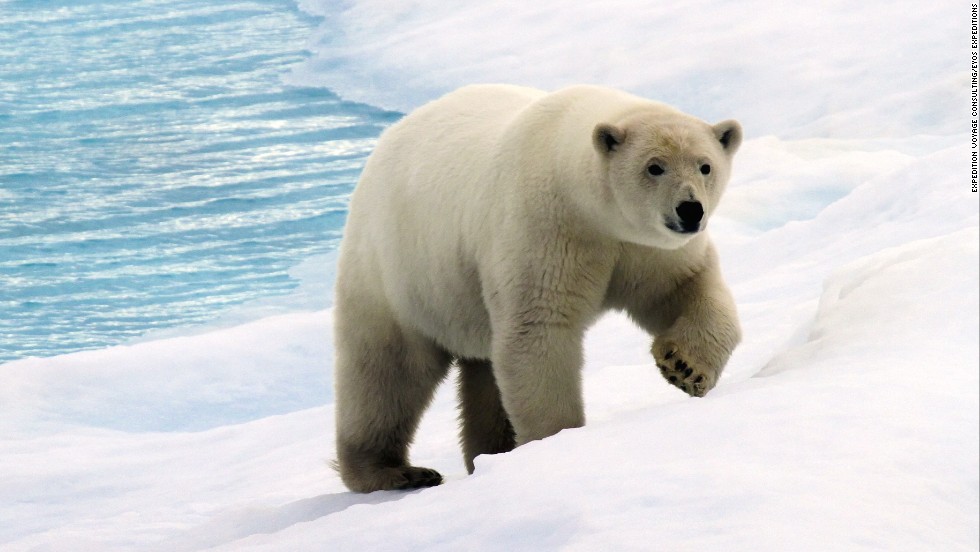
Arctic sea ice is a vital habitat for the polar bear. Photo: Expedition Voyage Consulting/EYOS Expeditions
A polar bear trudging across the ice. They are one of many species
endangered by the melting of the Arctic.
    
       When I reflect on this article, I realize that the science behind it is similar to what we have learned in class so far. For example, earlier this year we studied food chains and ecosystems, and how if a top predator is eliminated, it can trigger a “trophic cascade”. Because of the worsening situation of the melting ice caps in the Arctic, polar bears are being malnourished, possibly effecting their population. This means seals would be able to flourish without a large predator, eating away at the fish. As you can see, the Arctic food chain is very similar to ones we studied because of it’s delicate balance. This topic could also benefit society by contributing to scientists more about how the world works. From monitoring the ice movement and finding patterns, we might be able to figure out when major events (ice ages) happen in the weather. I found this article by looking on the CNN website, and this really stood out to me because I know the ice caps are a problem. After reading it, I agree with the author and the included video that something needs to be changed in order to fix it. However, I also wonder if this is normal for the Earth to experience, and the global warming we believe the culprit is not doing as much as predicted. From this article, I learned that the Arctic ice melting would not only effect the ecosystem, but the weather around us too, because the Arctic acts like a “big hat”. I also did not know that NASA is not only exploring other planets from above but also Earth. I think that’s really neat! Lastly, after reading this article, I wonder what is happening to the Antarctic ice. Is the reverse going on? Or is it also melting, at a slower or faster pace? In conclusion, this article was very fun for me to read and brought awareness to a small but growing problem.  "If the summer is cool, the melt rate will slow down. And the opposite is true, too: even if you start from a fairly high point, warm summer conditions make ice melt fast." - Walt Meier, NASA Space Flight Center, Goddard

Patrick.

Arctic Ice Travels Fast, Carrying Pollution

Arctic Ice Travels Fast, Carrying Pollution

Science News for Students
Written By: Thomas Sumner
Publication Date:January 6, 2016


This article was about how in the Arctic the ice is becoming thinner, and moving faster than ever before. At the moment, many scientists are involved in looking at how ice is moving. Anthony Mahoney, and Robert Newton, are both named scientists in the article. Right now, these scientists are just trying to figure out what is going on. In a recent experiment, by looking at satellite pictures, scientists were able to find that about 60% of ice only moves within 100 kilometers of its birthplace. However, the other 40% covered hundreds of thousands of square miles. This doesn’t seem like it should be a problem, but it is. What happens is that the wind picks up pollution from the south and brings it to the Arctic. The pollutants land on the ice and in the sea. That pollution, as well as other pollution from industries on the Arctic Coast like oil drilling, gold mining, and copper refining, gets trapped inside the ice when it freezes over in the fall. Then, if the ice is part of the “40%” it moves far away, and melts there, only to pollute that part of the ocean more. For example, if there is an oil spill in the summer, the oil might get onto the ice. More ice forms over the oil. From there the ice moves far from the Arctic Ocean, maybe to the Northern Atlantic, and melts there. Now that water is polluted with oil.  
   ““You might imagine that the ice is this pristine environment,” he said. “But that’s not true.” He notes that “ice in the Arctic is surprisingly polluted. And when the ice travels from one part of the Arctic to the other, it carries all that material with it.”" The “he” in this quote is Robert Newton. I think that this is an important quote from the article. The information in it is important, but what I think that we have to take out of this quote is that in a lot of things, in this case global warming, we think one thing, but in the end, that is not really the case.
There are a lot of articles about global warming, however I think that this one is special because it tells us something that many people are not aware of. I think that this information says that basically global warming is something that only speeds up as it continues to thrive. Because of the warming of the earth, pollution spreads more quickly. This discovery might not affect very many people, but I think that its content will. Picture this, pollution continues to spread, until at a point almost all of the world’s oceans are polluted. Millions of fish could die from this, think about a world without fish. Entire ecosystems could collapse, especially the ones in the sea. Not to mention the economy. Some countries are known for their fish industry, and if there are no fish, how will they make money? Think about how much food will be lost. So yes, I think that this discovery could affect everyone.
It saddens me that we are still finding problems every day that are to account to global warming. Although, it is nice to know that people are trying to learn about the problem. “Keep your friends close, but your enemies closer.” I think that this is a good way to describe what is happening with global warming right now. To be able to defeat something, or someone, you need to know how they play, and what their weaknesses are. Clearly, global warming is different from a sports team, but we still have to learn about it before we can conquer it. Scientists are trying to find as much information as possible so they can find effective and reasonable ways to defeat it. Also, this information changes how I thought about ice before I read this. Like the quote says in the second paragraph, I did think that ice was a “pristine element” created by nature. I would never have thought that under layers and layers of frozen water there could be so much harm.

In the end I believe that this was a very informative article, that brings me to a lot of new questions. There are good things and bad in the article, and a little bit of hope, that leads me to believe that we are on our way to, hopefully, a little bit of a brighter future on this planet.
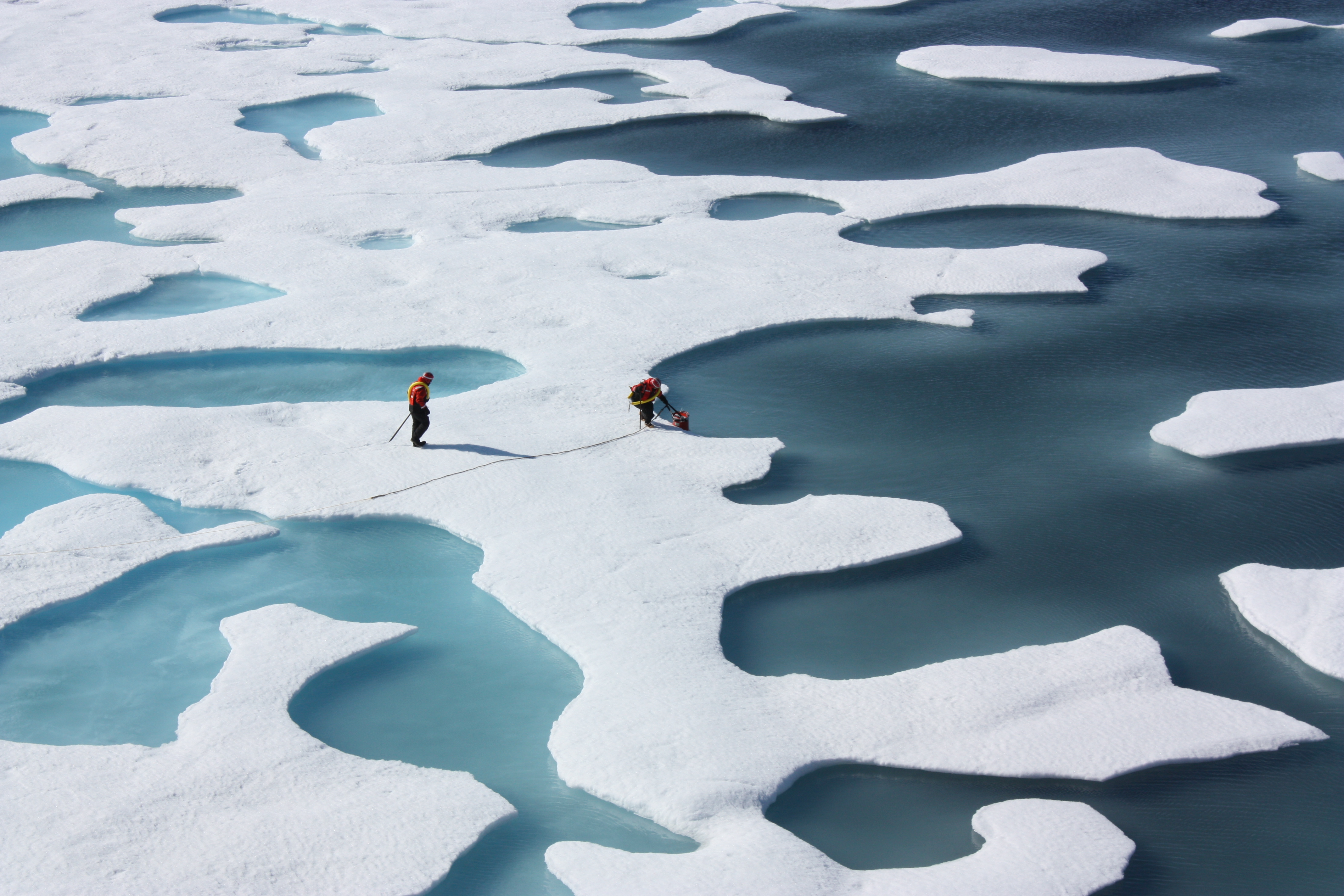
This image most likely shows scientists measuring the Arctic Ice.
https://upload.wikimedia.org/wikipedia/commons/c/ca/Ponds_on_the_Ocean,_ICESCAPE.jpg 

Ice and Pollution in the Arctic


Arctic ice travels fast, Carrying pollution
Student Science
BY THOMAS SUMNER 7:00 AM, JANUARY 6, 2016


Arctic ice is traveling very fast, and while it moves it carries pollution, and It started in 2014 and continues to happen.Quote:“ice in the Arctic is surprisingly polluted. And when the ice travels from one part of the Arctic to the other, it carries all that material with it.” -Robert Newton. Winds take airborne pollution, north from lower latitudes. Much of that pollution have settled into the ocean and the sea ice too. Gold mining, oil drilling and copper refining, also can pollute the region’s waters. Less ice could mean less space to carry a large load of pollutants and debris. But a less crowded Antarctic might let the ice travel farther and faster.
60 percent of ice travels less than 100 kilometers (62 miles) from where it was formed. The rest covers an area equal to tens of thousands of square kilometers. It can travel hundreds or even thousands of kilometers. 
Robert Newton thinks "the area of ice that travels a long distance over its lifetime is about eight to ten percent larger than it was even fifteen years ago." Ice now goes from Russia to Canada in four or five years or less. It takes six or seven years to cover that distance only fifteen years ago.
An oil spill during the summer could become trapped in this autumn ice. The oil could quickly move from one country’s waters to anthers, rapidly spreading the spill's impact on the environment.

ice oil rig
An Ice braking boat moving through the water, and braking the ice
SUMNER, THOMAS R. "Arctic Ice Travels Fast, Carrying Pollution." Student Science. Student Science, 6 Jan. 2016. Web. 18 Jan. 2016.