Showing posts with label global warming. Show all posts

Tuesday, June 12, 2018

Global Warming

https://www.ucsusa.org/our-work/global-warming/science-and-impacts/global-warming-science#.WxbygFMvzs Publisher: Union of Concerned Scientists
No date of publication

Reviewed by Wyatt


"The science is clear. Global warming is happening.

We are the primary cause.The science is clear. Global warming is happening."

The Global Warming Impacts article taught about all of the consequences of climate change such as temperature changes, rising sea levels, and wildfire seasons getting longer- just to name a few. It also talked about the science behind global warming. The main ideas of my article is to teach you about global warming and all of its effects on the environment and all of us. Did you know that the average global sea level has increased eight inches since 1880? The article also talked about how wildfire season is getting longer in the Western U.S. Another impact is that tens of millions of trees have died in the Rocky Mountains over the past 15 years from heavy droughts and insects and wildfires.  Recent research indicates that hurricanes are gaining their destructive power, or intensity, and it has been growing since the 1970s.  So basically, the article is teaching you about global warming so that you may want to make a difference in the world.

This news is important because we need everyone to realize how bad global warming is. it is useful because it teaches us about global warming. people who care about the world that we live on will care about this news. I choose this article because it taught me a lot more than other articles. we need this research to back up the fact that there is global warming and so we can prove it to all the people that don't believe in it. it does not directly affect me because i am not the only person that lives on the Earth.


I already knew about global warming. my reaction was confusion because we weren't doing anything
about global warming. I don't know about the exact temperature changes but the article taught me about them. people who don't think that global warming is real think that it is just fake and scientist are
just coming up with random stuff when really they have statistics to show that global warming is real.


We are the primary cause.

(Global warming) Confronting the realities of climate change

Union of Concerned Scientists
(Global warming) Confronting the realities of climate change

Union of concerned scientists INC 2017
“Certain consequences of global warming are now inevitable, including sea level rise, more frequent and severe heat waves, and growing wildfire risks. Even as we work to reduce global warming emissions, we must also prepare for this dangerous new reality. It’s only gonna get worse."-Union Of Concerned Scientists
Well in our current age our world is getter hotter and hotter. We must find a way to slow down the heating of our earth or somehow to stop it. Because the world is getting hotter more wildfire’s and other things with fire are acquiring and really causing damage to our environment. The polar ice capes Million of gallons of water is adding to the ocean from the ice it’s self. it’s really bad Our environment is being destroyed with everything we are doing to it. If we don’t do anything fast it’s only going to get worst till it get’s too hot. We are causing this. we are overloading our atmosphere with Co2 which traps heat and steadily increases the planets Temperature. There are many ways that we could start to lower our increase at our home and “we must stop de-forestation it accounts for about 10 percent of the world’s heat-trapping emissions. reducing tropical deforestation can significantly lower global warming emissions and plays an integral role in a comprehensive long-term solution to global warming”. As said by the union of concerned scientists. If we can do something about the deforestation we can slow down global warming right in its tracks. But if we don’t do anything it’s only going to get worse and it will lead us to wish that we had done something. Global warming could definitely be the end of us if we don’t do anything would you really want to die to global warming I definitely wouldn’t so we must do something.

Image result for global warming over the years Well, this news is important because it is destroying our world and causing more wildfires and the sea level is rising so much we are having more floods than ever. This is info is useful because now I know all the this that global warming is causing and how we could solve some of them. The whole world will feel the global warming along the sea with forests this news can shock the world into fixing what we are doing if everyone knew what was occurring. Well, the difference it makes is it is making the world hotter and it is affecting everyone heath by it getting hotter and hotter. well, this article had a ton of valuable information. Because this is such a big topic with so many things going on and being caused by global warming. well, it affects me in a way that makes me mad that we are destroying our world by chopping trees and adding A lot more Co2 because not enough plants to have the co2.

I think that it is time for us to take action at this event. This event is slowly ruining our planet and everything that we care for It is ruining our health and increasing floods and forest fires all over the world. To what I am seeing there are no Pros to global warming but there are many cons with everything being in 2060 the world is going to be mostly dry land if we don't find a way to slow down global warming. After researching this topic Global warming has become something that I care and know more about so my understanding has definitely changed a lot. If you are ok with global warming I think you are crazy global warming is destroying our world and if you are against global warming I agree this needs to be put to an end.

Wednesday, June 6, 2018

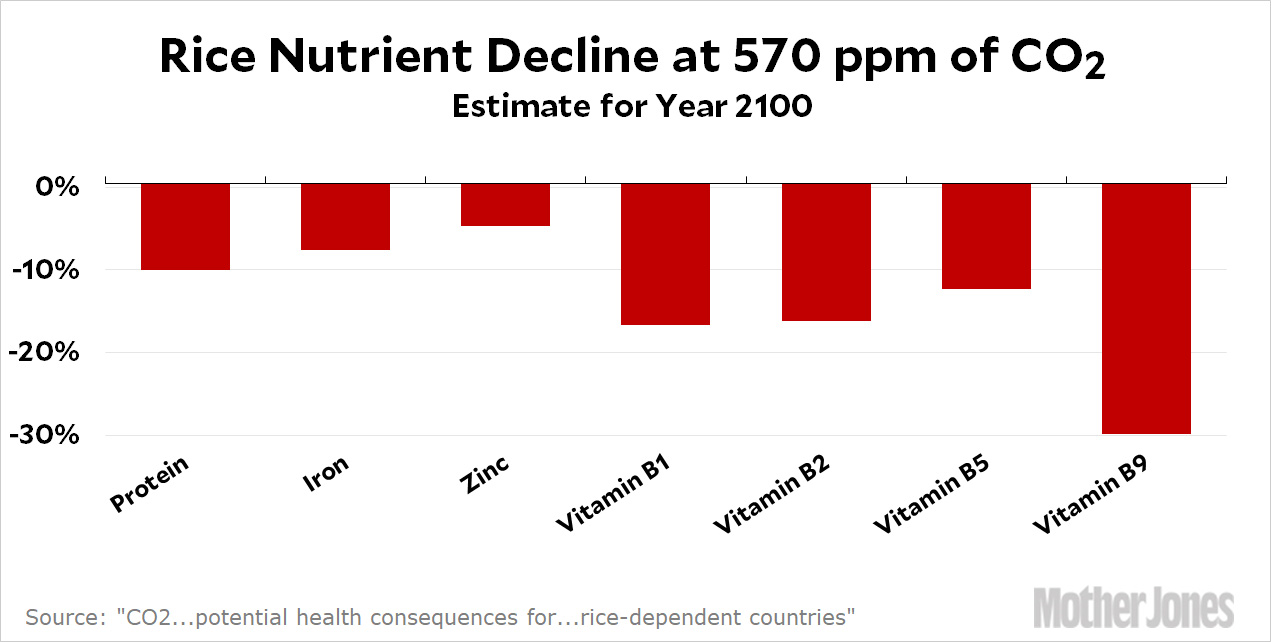
Increased CO2 levels are decreasing vitamin B in rice


As CO2 increases, rice loses B vitamins and other nutrients


BY Susan Milius

on may 23, 2018

published by  Society for Science & the Public

“By the end of this century, rice may not deliver the same B vitamin levels that it does today.”


Before reading the article I knew that global warming is not good for the environment and can be harmful to many species.
Rice is losing nutrients
The increase of Co2 levels is decreasing the amount of vitamin B in rice. Not only vitamin b but protein, zinc, and iron too. This will cause people who have a lot of rice in their diet to not get as much protein and those other essential vitamins. These proteins and vitamin
Table of the decline of nutrients in rice    
losses will cause those people to be more likely to get diseases such as anemia and beriberi. Rice is a staple food in many people’s diets and it will not be good for them for rice to lose protein. A lot of people in the world can’t afford protein-rich foods and rice is a cheap food for people to buy and if there is less protein in rice they will get even less protein. So this problem will affect the economic part of society in that poor people will be more susceptible to diseases and it will delay the rise from poverty in our world Scientist discovered this by exposing rice to more Co2 than normal today and found the loss of the important proteins and vitamin B. According to Vox scientists think that the reason that Co2 levels are affecting the rice is “It could be that if plants can draw on more carbon dioxide, they need less of other nutrients. It could also be that as crops produce more grains, the nutrients are diluted. Carbon dioxide also causes stomates, pores in plant leaves, to close. This, in turn, changes the flow of water through the plant, which may affect how water-soluble nutrients accumulate.”
Percent of the nutrient loss in rice 

This news is important for people who have a lot of rice in their diet and hopefully, they can add some other foods with the stuff the rice may be lacking in the future. This impacts a lot of people in Asia who eat a lot of rice. People needed to research this because people will need to find another cheap food that has some of the same proteins and vitamins so that people without a lot of money can still afford to get those vitamins.

I think that it is not good and that we can easily stop this if we just stop polluting the environment. Lots of people eat rice and this will affect so many people. It is just another bad thing that is happening with all the Co2 we are pumping into the environment. We put 2.4 million pounds of Co2 into the atmosphere every second and we need to stop.


How is Wildlife Affected by Global Warming?

Name: How is Wild Life Affected by Global Warming?
Publisher: Earth Talk
Date: Updated July 24, 2017


Reviewed by: Abby 

“Beyond habitat displacement, many scientists agree that global warming is causing a shift in the timing of
various natural cyclical events in the lives of animals - a pattern called phenology.”

I didn’t know anything about Global Warming affecting animals until I read the article and looked deeper into this topic. All I knew was that global warming was melting glaciers.

All animals including humans are involved in this because we all live on this earth. Plants are also involved in global warming. It will affect everyone and everything that is on planet earth because global warming is affecting the whole earth even if it is in the smallest way.

Many scientists have discovered that global warming is melting glaciers and ice up north and even in Maine it is warming up the ocean, making it possible for more species to come and invade and eat the less protected species to extinction. Scientists have also compared the climates now in different places to the climate they were years ago, or compare them to each year.

Global warming has taken place for many years. We didn’t know for a while until we realized ice around the world was melting.

Global warming has taken place all around the world. More places are more noticeable than others, but it is affecting the whole world.

Global warming has taken place mostly because of humans. There are so many gases in the air these days, that the gases are trapping heat and then the heat just keeps rising. Before there was enough gas to trap heat, the temperature was rising but at a much slower rate that was almost unnoticeable.

Some are trying to solve this problem by making things that put less gas into the atmosphere. Others are trying to make places for struggling animal species to reproduce and not go extinct.  There isn’t a lot that people can do right now but many scientists are studying this so that they can find a way to stop this.

The Maine focus in the article “How is Wildlife Affected by Global Warming?” is to make people aware of what global warming is doing to the animals. Including their behavior, their habitats, and their food and water sources.
Behavior is a big part of the ecosystem because if animals end hibernation early they could starve if they eat
plants because the plants might not be producing fruit yet. Their habitats could be damaged by heat and sudden
temperature changes. Rivers can also dry up because of global warming or they could flood because if ice
melting. There are many consequences to global warming and that wasn’t even half of them.

This is news is important for the whole world to know so that they can choose to use things that put less gas into
the air and they can also donate to researching global warming. People can also donate to animal reserves so
that animals that are going extinct can have a place to live and repopulate. The people who are most likely to
feel the impact of this news is scientists and animal lovers. This news will make scientists want to research this
more and it will make animal lovers want to donate and help animals that are in major trouble from global
warming. I chose this article because I love animals and this sparked my interest in global warming because
I had no idea before this that animals could be impacted in such a way. There is a need for this research
because sooner or later animals could go extinct and glaciers could melt and oceans could heat up and this
could be very bad for the human and animal population. This article does not directly affect me.

I think that this is not good and that we should try and make more machines that don’t put gas into the
atmosphere. This article
showed me what can and is happening to animals around the globe. This information has made me
 think how bad some gases are for the earth and for our health.
Some pictures are misleading. All of the animals in this picture are strong swimmers.

CO2 is one of the maine reasons we think global warming is present

https://www.google.com/search?q=global+warming&source=lnms&tbm=isch&sa=X&ved=0ahUKEwiqje6u59DbAhXLqFkKHbJVAcoQ_AUICygC&biw=1202&bih=544


Global Warming


Global Warming, Union of Concerned Scientists, 2017, https://www.ucsusa.org/global-warming#.WxFjPlMvzsk
Global Warming 101, NRDC, March 11, 2016, https://www.nrdc.org/stories/global-warming-101
How Does Global Warming Affect Animals, ThoughtCo, July 24 2017, https://www.thoughtco.com/how-wildlife-affected-by-global-warming-1203849

Reviewed by: Ethan

“Global warming is already having significant and harmful effects on our communities, our health, and our climate.”
Image result for global warming
Polar bear stuck on melting ice.


After reading these articles, the main idea I have learned is that the heat is rising. Scientists have figured out that human activity is the main cause of global warming. This is because we are overloading the atmosphere with carbon dioxide, which traps heat and slowly raises the planet’s temperature, this is called the greenhouse effect. All of this carbon dioxide comes from us burning oil, natural gas, and coal. But this main idea drags down into many other cons that have been increased because of global warming. One of these is the sea levels rising, the cities on the coast have had an increased risk in flooding, especially in the Gulf of Mexico, and the U.S East Coast. Wildfires have also been occurring more often, and the wildfire season has grown longer in Western U.S. The air pollution has also decreased our health, and has made an impact on a longer and harder allergy season. Animals have also been tied in to all of this madness, the polar bears, have been standing on melting ice caps for quite some time. And are soon not going to have anywhere to go, and they will sadly, eventually die. There are many more cons of this problem but I won’t explain them all. But, so far we don’t have a main solution to stop global warming, but scientists have figured out ways to help decrease the increase in temperature. One of these major ways, is to stop deforestation. according to researches, 10% of the heat trap is caused by tropical deforestation. If we stop then the heat would significantly decrease. If we stop global warming the world would be a much cooler place.

Image result for global warming
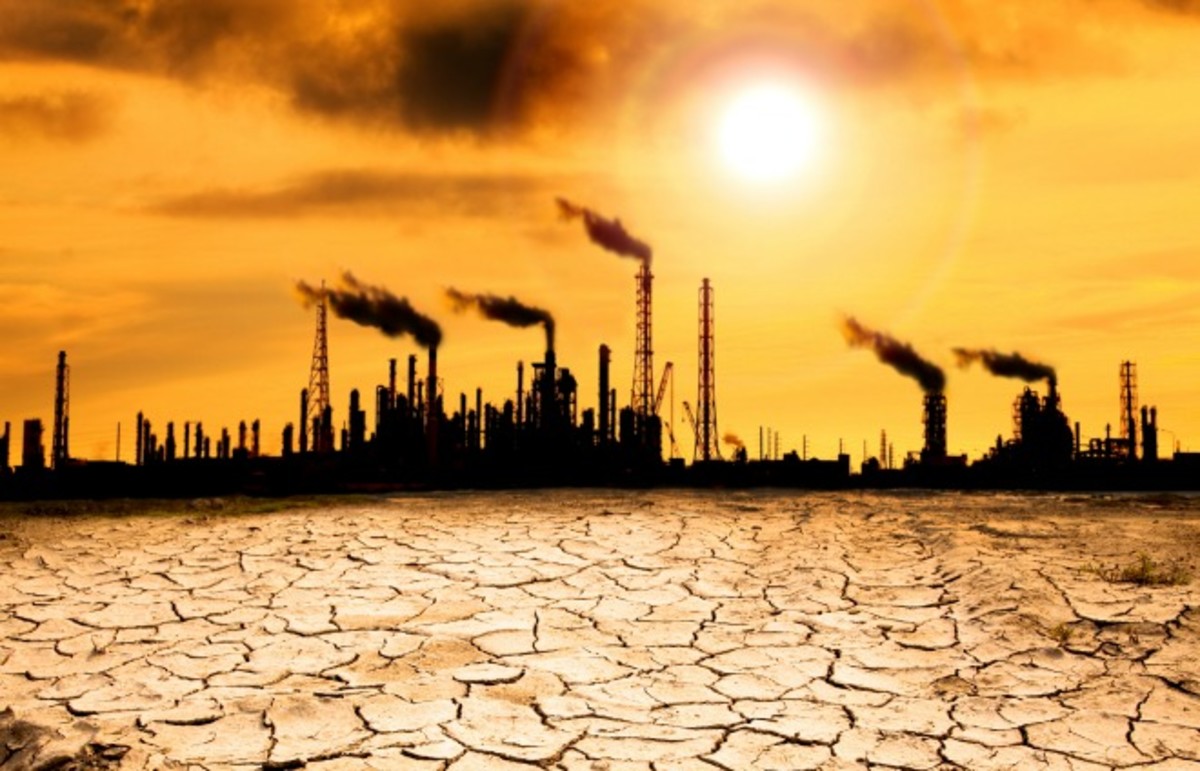
Burning gas negatively affecting the environment. 

I feel this like this topic is important to me because if we don’t stop the rising heat the many animals could be at risk for extinction like polar bears, so far, they are standing on tiny blocks of ice, until the ice blocks finally melt. And besides, people are going to be very annoyed with the heat outside their house. If we didn’t start research on this earlier, the heat would’ve been higher then it already was, and that would’ve definitely increased the risk of sunburns. These articles affected me because, they were trying to convince the reader, to try and help stop global warming. I feel this topic is very important because if this temperature keeps coming many animals might go extinct. And death from burns will be more common.

I wasn’t really surprised at the information I found from the websites, but I did find more information on the topic and its negatives. This information is good to know, because if people know what the cons are, the heat wouldn’t keep getting worse. These articles surprised with all the information it was serving, at first I thought global warming only meant increased temperature, but no I know that there are many more cons toward global warming. My understanding of this topic has greatly increased by reading these articles, and now I know what other people have to struggle through on the other side of the world. The cons are that sea level is rising, and that could risk more floods for coastal villages and cities. Air pollution has also decreased our health, and leading to a longer and harder allergy season.


Tuesday, January 19, 2016

2100 Prediction; Parts of Earth Will Be "Unlivable"

Places in the Middle East, the Persian Gulf Region, May Soon Become “Unlivable”
Link to article: http://www.cnn.com/2015/10/27/world/persian-gulf-heat-climate-change/index.html
Article title: Persian Gulf heat: It may become too hot for humans to survive, study warns
By: Brandon Miller, CNN Meteorologist
Source: Web; article
Publisher: CNN.com
Date published: Wednesday, October 28, 2015

The main idea/summary of the article, “Persian Gulf Heat: It may become too hot for humans to survive, study warns,” is that authors from Loyola Marymount University and Massachusetts Institute of Technology (MIT), discovered that by 2100, places in the Middle East, the Persian Gulf region, may be unfit for humans to live or be “unlivable.” So, the “who” of the article is the authors from Loyola Marymount University and the Massachusetts Institute of Technology (MIT), who discovered this horrific prediction and were involved, but also the people living in the Middle East, who are going to ultimately be affected. The “what” of the article is that in terms of what has been discovered, is that with a drastic change of climate, aided by global warming, places in the Middle East, the Persian Gulf region, and its major cities like Dubai and Abu Dhabi, can become unable for humans to survive and live there, or be “unlivable” by 2100. Although the “what,” “why” and “how” of the article, in terms of how this discovery was found, was that they, the authors, found the discovery by realizing that by 2100 places in the Middle East will be too blistering hot in the summer. They figured this out by taking note that while global temperatures become higher due to greenhouse gas emissions, areas in the Middle East would most likely be the first to reach the level where it would be unfit for humans to survive because it already very hot. However, they concluded that this wasn’t much of a problem due to a process called evaporative cooling. It’s when you react to heat by sweating, and then the sweat on your skin evaporates, cooling you off.
Although, that helps, but the scientists then realized that as the moisture and temperature increases, the process becomes less and less effective. Sometimes it even reaches a place where a body can no longer cool down. So, they realized that when evaporative cooling is no longer very effective, the heat of places in the Middle East was still a problem. Then, they clarified their discovery by looking at a value called “wet-bulb temperature.” It is a value that compounds air temperature and humidity together. The authors ran studies to see how this changed over time with increasing greenhouse gas concentrations. This allowed them to see how summertime conditions in individual cities, such as Abu Dhabi and Dubai, will change by 2100. They came up with a horrific prediction. Currently, the wet-bulb temperature only exceeds 31ºC (88ºF). It never gets to 35ºC (95ºF), a lethal temperature. Although, by 2100, many regions along the Persian Gulf, including Dubai, will see the wet-bulb temperature reach 31ºC on an average summer day. On some days the wet-bulb temperature could exceed the lethal state of 35ºC. Also, the “when” of the article is that the studies took place around approximately the date of publication, Wednesday, October 28, 2015, and the authors predict that places in the Middle east will be “unlivable” by 2100. The “where” of the article is that obviously in the location of the Middle East, areas will become “unlivable” for humans. So, the main idea/summary of the article is that is that authors from Loyola Marymount University and Massachusetts Institute of Technology (MIT), discovered that by 2100, places in the Middle East, the Persian Gulf region, may be unfit for humans to live or be “unlivable.” They found this by using their knowledge of evaporative cooling and a value called wet-bulb temperature.
One quote from the article I thought that best stated what is important to know about this news was, “All is not doom and gloom in the study, however.” This quote best states what is important to know about this news because instead of allowing people to be consumed in guilt about whether or not they have contributed to greenhouse gas emissions and global warming, which will obviously as the article states have a drastic affect on places in the Middle East by 2100, it reminds people that there is hope, that it may not happen by 2100, it could happen possibly much later. Also, it picks people up by giving them something to work for, to stop global warming and greenhouse emissions that could lead to places in the Middle East, the Persian Gulf region, and major cities like Dubai and Abu Dhabi becoming “unlivable” by 2100. So, I believe that this quote best states what is important to know about this news.
With my reflection of the article, I analyzed it deeply and I made an abundant amount of connections. For example, I made the connection that this article was related to what we our currently studying in class and a general area of biology/human anatomy by noticing that the article explains that a person’s body cools by sweating and reacting to heat. Then, the sweat on our skin evaporates and cools us with a process known as evaporative cooling. Although, sometimes the heat and humidity can be so high, that a person can no longer cool down, and that is where they find themselves in deep water. This is in fact, what will happen to our bodies in places in the Middle East by 2100, the article actually explains. The article also relates to biology/ human anatomy by explaining a value called “wet-bulb temperature.” It is a value that compounds air temperature and humidity together. The article explained that scientists ran studies to see how this changed over time with increasing greenhouse gas concentrations. This allowed the authors to see how summertime conditions in places in the Middle East will change by 2100. This relates to human anatomy by explaining that a person can only withstand wet-bulb temperatures up to approximately 34ºC, before the wet-bulb temperature hits 35ºC, a lethal temperature for humans. So, my article relates to the general area of biology/ human anatomy of the human body.
In addition, I made the connection that I didn’t specifically know anything about a human body relating to evaporative cooling and wet-bulb temperature, before I read my article. I knew that global warming can be caused by gases and transportation, and it is causing the world to get warmer. However, now I have learned about evaporative cooling and wet-bulb temperature and how they play a part in a discovery or research project. Also, I learned that global warming is much more bigger than just causing the world to get warmer. I realized that global warming can play a part in causing a whole area to become “extinct,” “unlivable,” and literally unfit for humans to survive! So, I made the connection that the information from the article definitely changes my understanding of this topic. Also, I made the connection that this news is really important because it makes people aware of the problems we could be possibly facing in the future, and what we can do to stop the problems from happening. It is useful because it provides the feedback I mentioned above, but it also explains how the scientists and authors found their discovery. With this, by explaining their method, it gives other people and scientists knowledge of how to experiment with problems like this, which could be useful in their own experiments. I also realized I chose this article because I am very concerned about the world my (possible) family will grow up in. Based on that, if there is anything negative, I want to do what I can to change that.
Meanwhile, as I reflect on the article, I think the pros with the article is that I feel happy that they are getting the word out to people, including myself, and explaining what is happening so we can do our job to prevent it from happening. In addition, the article has a major “pro” in itself which is that places in the Middle East may not even become “unlivable” by 2100, possibly much after. However, the cons I feel about this article is that the news can cause people to overstress about it. Also, people might not pay attention to it and just take it for granted that other people will take care of it. Which in fact, is absolutely not true. In a situation like this every mind and body counts. So, with my reflection of the article, I analyzed it deeply and I made an abundant amount of connections.
Finally, my critique of the article is fairly positive but a little negative. Since I am sometimes confused on how scientists get to their final conclusion, I loved how the article explained and was able to make me really understand how they came to their prediction that places in the Middle East can become “unlivable” by 2100. The article explained this and really lended a hand in helping me comprehend it by explaining how they used wet-bulb temperature and evaporative cooling. In addition, they did a great job persuading me that this prediction is a real danger, which I really like and appreciate. They did this by again, explaining the value wet-bulb temperature and what it would be like in places in the Middle East by 2100. “By 2100, however, many regions along the Persian Gulf, such as Dubai, will see this value reach 31°C on an average summer day and the most extreme days could exceed the lethal value of 35°C.“ So, as I said in my cons, I wonder if people will take this article seriously, like the text convinced me to do. Therefore, my critique of the article is fairly positive but a little negative.
Places in the Middle East, the Persian Gulf region, can become unfit for humans to live or become “unlivable” by 2100 authors from Loyola Marymount University and Massachusetts Institute of Technology (MIT) discovered.
http://www.persiansarenotarabs.com/persian-gulf/