Title: Australian researchers combat bee decline with tiny trackers
Written By: Michael Pearson
Published: Tue August 25, 2015, CNN
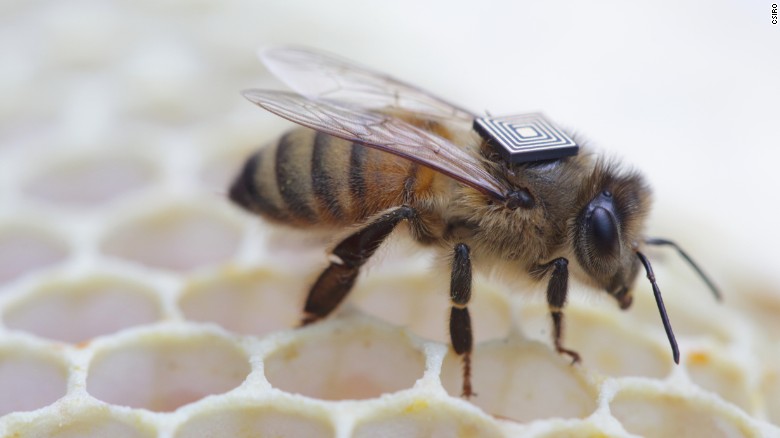
Data has shown the decrease in numbers of the honeybee population over various time periods, but very few people are doing anything about it. After all, why would they? To many people, a honey bee is just a small insect that can sting. What many people don’t realize, is that honey bees are responsible for providing pollination of one third of the foods we eat. With the number of bees decreasing, it gets harder and harder to pollinate both crops and flowers. From April 2014 to April 2015 alone, U.S. beekeepers have lost a total of 42.1% of their colonies. Why? That is what many people across the globe are trying to figure out. There have been different attempts to increase the bee population, though so far, they haven’t worked. Australian researchers’ newest idea is something called the “bee backpack”. The “bee backpack” is a tiny micro-sensor that is able to track the location of the bee to which it is secured. It is tested by the Commonwealth Scientific and Industrial Research Organization of Australia, where the bee population is not in decline. The hopes for this experiment is to be able to see how the bee’s environment affects their movement. By following their movement, researchers can understand the bee’s stress factors.
The information gathered in this experiment is important, as it can save lives of many bees, make a breakthrough in the technology world, and affect much of our food supply. Though there are many strengths to this technology, it has its limits. As it can only detect location and movement, there is only hope that scientists can analyze what in a particular environment is causing the bee stress. The micro-sensor can fail, or fall off of the bee’s backs, as the only thing securing it is glue. The data collected from a certain bee might not reflect the behavior of all bees. After reading this article, it made me wonder if, in the future, people will install technology inside the bee that can detect pulse as well as location, so scientists can be sure of how bees are responding. Is there a less labor-intensive way to place the micro-sensors on the bees, so that more bees can be tracked. If the technology is able to gather enough information for scientists to analyze, it could save many bees lives. It is a problem, not only that bees are decreasing, but also that the reason of the decline is unknown.
There are many ways that saving the bee population connects to what we have been studying in class. We have learned about the plant life cycle, and how plants are pollinated, and that for a plant to reproduce, it needs to be pollinated. There are many ways a plant can be pollinated, but one of the most common ways is by pollinators, such as a bee. Without bees, the pollination of a plant relays on wind, water, people, or other animals, which are a more uncommon form of pollination. This article also relates to the technology world, and how to track different objects using micro technology. The way of tracking different objects is used in many ways today, such as theft-prevention, data collection, and GPS.
“The tiny technology allows researchers to analyze the effects of stress factors including disease, pesticides, air pollution, water contamination, diet and extreme weather on the movements of bees and their ability to pollinate,” The organization’s science leader, Paulo De Souza, summarizes the main hopes for the project. The quote shows how scientists are analyzing the technology’s data. I think this quote also shows the basic premise of the experiment, and what types of problems scientists think limit the bees.
I chose this article because I wanted to learn more about honeybees, and what people are doing to prevent their decrease in population. I also wanted to learn more about technology, so it is interesting to see the different ways using new technology can help the honeybees. If people can fit a tracker into something less than a ½ of centimeter cube, it shows what else people can do with technology.
 |
| The "bee backpack" used to track Honeybee's location |
http://i2.cdn.turner.com/cnnnext/dam/assets/150825161121-honey-bee-backpack-exlarge-169.jpg