Thursday, January 28, 2016

Current Events Project

I have done research on an article about part of a human skull that that was found in the Afar region of Ethiopia. This human was named Australopithecus Deyiremeda. CNN said  “the name, Australopithecus deyiremeda, derives from the local Afar language and means "close relative" -- referring, the researchers say, to "the species being a close relative of all later hominins." This human was estimated to be living about 3.5 million years ago which could be compared with the human bones found in the 1970’s that was named Lucy by the people. The leading researcher in the project, Yohannes Haile-Sellasie used the term “Hominin” that means hominids that includes “recent humans together with extinct ancestral and related forms.” The quote coming from the researchers is "Current fossil evidence from the Woranso-Mille study area clearly shows that there were at least two, if not three, early human species living at the same time and in close geographic proximity."

Overall, this is a great discovery has lots of pros for the human race, we can find our origins, solve mysteries of the past or even use that dna! I think that this is not “earth shaking” like some other topics but it is still very interesting to see how we have evolved over the years. The reason I chose this project was because I was very interested in the early human that was found in the 70’s, name “Lucy.” I do not think that this even remotely as important as the discovery of Lucy because only parts of the jaw and head were found, as opposed to the whole body of Lucy. I think that scientists should keep searching for more bones in Ethiopia because that is where lucy and these other bones have been found in Ethiopia. Overall, I think that there will be nothing but good things to say about this amazing discovery.


May 28, 2015

Monday, January 25, 2016

DNA

Odin              DNA
1/19/16


I read and found an article about DNA (Deoxyribonucleic Acid) DNA is a the assortment of cells in the body and the physical traits of the human being, this article was made by Eric D. Green, M.D., Ph.D. It is used to help us classify human being, understand the human body and sometimes even in solving crimes that we humans have committed. It was created by Friedrich Miescher in 1869 at the University of Tübingen which changed the way we identify humans to be different. He didn't have a reason to find this but if he did I almost guarantee it would be to help out and find out what diseases are in people. It also could help solve the amount of crimes and mistakes people were making back then. For instance buried alive, because remember science wasn’t the same back then they sometimes couldn’t tell the difference from sleeping and dead was. But that is what I assume his question or reason would be to find this discovery.


I chose to read this article because I always wondered how DNA worked and how they processed it. DNA is a very complicated thing and I never really understood it until now. I just knew that it was something we had and tells who we are. I was looking just for websites under DNA and I found this and I realized this was one of hundreds of articles. I agree on what the author thinks of DNA and I love how he explains it, although he is not to serious about it all through the article. Since we are studying plants and cells of monocots and dicots there are a lot of similar things like both of them have a nucleus, and both of them have cells that control them. Although I wonder how they found it and what technology they used to see it as well as what type of DNA it is.
It was very reliable and it had just about everything I needed to make a great response. Plus it doesn’t just have an article on DNA it has another one on the genome and other things about the human body. All in all it had reliable resource and it expressed it very clearly. One thing I wondered was also if you know how to find DNA maybe through that you can figure out how to change it. When I look at plant and notice there is a thing called a perfect flower, I wonder if it is possible that the same can be said with any living thing. I wanted to look into this because I always thought scientist that dealt with the human body was cool and I was always very intrigued.


Pompeii Victims' Bodies Revealed in Scans

Written By Rossella Lorenzi
Discovery News

About 2,000 years ago Mount.Vesuvius erupted killing about 2,000 people in Pompeii. Pompeii was hidden under 8-9 feet of ash. Giuseppe Fiorelli and his team found that the bodies were covered in layers of ash and pumice, so they filled the hollow bodies with plaster making a plaster casts of the bodies they found. Stabia and Herculaneum started CT scanning the plaster casts of the 86 bodies created by Fiorelli. Of all the bodies, they found a boy who was about 4 years old. He was next to two adults(Male and Female) who were most likely his parents, also there was a baby on his mother's lap  CT scans could tell what his clothing was that he was wearing and specific spots of his skeleton. Many people died from head injuries because they were trying to escape but debris from buildings falling over. Humans in the town of Pompeii had about perfect teeth. Some had cavities but most of them were excellent. They also ate a lot of vegetables and fruit and almost no sugar. Fiorelli’s scanned about 30 men, woman, a boar and a dog.   

I chose this article because I have always been interested in Volcanoes and I found the news very interesting. This article affects me by how many people died in Pompeii. When I was reading this article it was really cool how the scientists could find if they had any issues with their bodies like head injuries or any tooth issues. They could also know what they ate. All with just a CT scan. This article made me think of what scientists can do with other massive volcanoes maybe ones bigger than Pompeii.Another thing I thought was cool about this article was that the scientists could scan a wild boar and a dog.In conclusion, This article was very interesting and learning packed.

Friday, January 22, 2016

Red meat Cancer study

Back off the bacon and cold cuts


By Stephen Ornes
January 8, 2016

The World Health Organization recently determined after countless studies that consuming too much red meat leads to a more likely chance to cancer. “You shouldn't be eating well-done cooked meats, or barbecued chickens, or barbecued steaks, or processed meats every single day,” says Robert Turesky. Robert Turesky is a food scientist at the University of Minnesota. Studies have shown that the hazardous chemicals once in the body can cause diseases  such as cancer, “too much of anything is unhealthy” He warns.  


This article is important because every year, 130,000 people are diagnosed with Colorectal cancer almost half will die. If you eat 50 grams or more of red meat/ processed meats each day, then you have a great chance of being diagnosed with Colorectal cancer. Colorectal cancer starts in the Colon or Rectum and cells grow into tumors. Cancerous  cells may enter the bloodstream, travel to
other places in your body and grow new tumors.

I Eat a lot of meat and I heard that a lot of meat was bad for you but I never really knew that it was this bad. I was shocked and it makes sense that processed meat can cause cancer. My opinion is that if people want to eat a lot of red processed meat that's fine as long as they know that risks. The risks are there and they are high but nobody can just stop meat production. I believe that everyone should know the risks and they can take them if they want..


meat case


Thursday, January 21, 2016

"Racing Extinction"

  Link to Article
'Racing Extinction': Documentary Explores Global Loss of Wildlife
Publication Date: Nov 30 2015, 4:50 PM
by Munir Atalla, Cynthia Mcfadden, and Jake Whitman


My article is about the extinction of species all over the world and how humans are not trying hard enough to stop this mass extinction, and how we could in a number of ways. The article is based on the documentary that came out in early December 2015.  The documentary was made to bring the focus to the fact that this is actually the only mass extinction caused by one specific species, humans. But it’s main point was to form a person connection between viewer and animal, for example I took notice to the story about manta rays that are being hunted off the coast Indonesia. The manta rays are being hunted for one reason and one reason only, for their gills. There gills are used in ancient chinese medicine. But think about it, these poor animals have never done a thing to these hunters and they are being killed for only one resource. They are wasting an entire manta ray just for their gills, in fact there meat is not is not even tasty. It’s something that really made me want to somehow change the state that these manta rays are in.
I honestly don’t think there are any cons to this article. It shines a light on a topic that certainly is forgotten.   People always think “oh that’s someone else's problem.” Just like as it’s said in the documentary.
One thing that really surprised me in the documentary was one quote that Louie Phishoyos said “The biggest mass extinction since the dinosaurs” and that really shocked me because to think that we are living in a time where our planet may be going through something that could possibly be killing it. And most of us are just sitting back and letting it happen. It also pointed out that there are people all around the world trying to preserve these species and could possibly be putting their lives in  danger for these animals.
Overall I would recommend not only this article but also further knowledge of the issue it is discussing. It’s something that I think everyone should learn about considering the circumstances our planet is in. After all the extinction of these beloved animals.

Tuesday, January 19, 2016

Australian Researchers Hope to Find the Reason of Honeybee Decline


Title: Australian researchers combat bee decline with tiny trackers
Written By: Michael Pearson
Published: Tue August 25, 2015, CNN

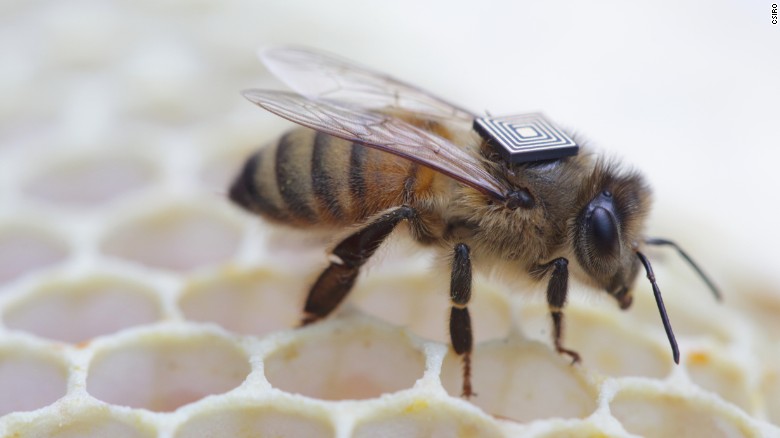
Data has shown the decrease in numbers of the honeybee population over various time periods, but very few people are doing anything about it.  After all, why would they? To many people, a honey bee is just a small insect that can sting. What many people don’t realize, is that honey bees are responsible for providing pollination of  one third of the foods we eat. With the number of bees decreasing, it gets harder and harder to pollinate both crops and flowers. From April 2014 to April 2015 alone, U.S. beekeepers have lost a total of 42.1% of their colonies. Why? That is what many people across the globe are trying to figure out. There have been different attempts to increase the bee population, though so far, they haven’t worked. Australian researchers’ newest idea is something called the “bee backpack”. The “bee backpack” is a tiny micro-sensor that is able to track the location of the bee to which it is secured. It is tested by the Commonwealth Scientific and Industrial Research Organization of Australia, where the bee population is not in decline. The hopes for this experiment is to be able to see how the bee’s environment affects their movement. By following their movement, researchers can understand the bee’s stress factors.
The information gathered in this experiment is important, as it can save lives of many bees, make a breakthrough in the technology world, and affect much of our food supply. Though there are many strengths to this technology, it has its limits. As it can only detect location and movement, there is only hope that scientists can analyze what in a particular environment is causing the bee stress. The micro-sensor can fail, or fall off of the bee’s backs, as the only thing securing it is glue. The data collected from a certain bee might not reflect the behavior of all bees. After reading this article, it made me wonder if, in the future, people will install technology inside the bee that can detect pulse as well as location, so scientists can be sure of how bees are responding. Is there a less labor-intensive way to place the micro-sensors on the bees, so that more bees can be tracked. If the technology is able to gather enough information for scientists to analyze, it could save many bees lives. It is a problem, not only that bees are decreasing, but also that the reason of the decline is unknown.
There are many ways that saving the bee population connects to what we have been studying in class. We have learned about the plant life cycle, and how plants are pollinated, and that for a plant to reproduce, it needs to be pollinated. There are many ways a plant can be pollinated, but one of the most common ways is by pollinators, such as a bee. Without bees, the pollination of a plant relays on wind, water, people, or other animals, which are a more uncommon form of pollination. This article also relates to the technology world, and how to track different objects using micro technology. The way of tracking different objects is used in many ways today, such as theft-prevention, data collection, and GPS.
“The tiny technology allows researchers to analyze the effects of stress factors including disease, pesticides, air pollution, water contamination, diet and extreme weather on the movements of bees and their ability to pollinate,” The organization’s science leader, Paulo De Souza, summarizes the main hopes for the project.  The quote shows how scientists are analyzing the technology’s data. I think this quote also shows the basic premise of the experiment, and what types of problems scientists think limit the bees.
I chose this article because I wanted to learn more about honeybees, and what people are doing to prevent their decrease in population. I also wanted to learn more about technology, so it is interesting to see the different ways using new technology can help the honeybees. If people can fit a tracker into something less than a ½ of centimeter cube, it shows what else people can do with technology.
Image result for Australian researchers combat bee decline with tiny trackers
The "bee backpack" used to track Honeybee's location
http://i2.cdn.turner.com/cnnnext/dam/assets/150825161121-honey-bee-backpack-exlarge-169.jpg

Chimps know when they've nailed a test, studies say

By Ben Brumfield, CNN
Updated 9:54 AM ET, Wed June 10, 2015


According to researchers of universities in Georgia, South Carolina and New York, Chimpanzees know when they get a question right. These Monkeys have almost the same level of metacognition that us humans do. Metacognition is when you know that you know something. Researchers found this in a few tests they provided the Chimps with in June 2015. They put computerized memory chips in their heads and when they got the answers right, they were rewarded with food. When the answer was correct, the food appeared out of the test area. The Chimps were alerted by a sound that was a little delayed. If the Chimps didn’t get to the food fast enough, it would be thrown away. Therefore they had to predict if they got the answer right to arrive at the food station before the food was available. The Chimps predicted it almost every time therefore showing that they have almost the same level of metacognition as us. Researchers could use this information to get us closer to communicating to Chimps. It can be helpful to understand more about the evolution of humans and what we used to be like. Now that we know that, people may be more considerate and more willing to make donations to help Chimps and other monkeys out in the wild who need help.
I chose this article because I found the news super interesting and I wanted to know more about how Chimps are related to us. This article doesn’t directly affect me but I suppose it affects everyone in some way because we evolved from apes.
I thought that this was very interesting to know and when I saw the heading of the article I immediately wanted to know more. As I started reading I came across this “It's more than just knowing something. metacognition is knowing that you know something. Like humans, chimps can think about their thinking and change their behavior as a result, the researchers believe.” I thought that this was really cool to know and I realized that Chimps might be even closer to us than I thought. I mean they’re animals and we are humans but they have quite a lot of intelligence. metacognition is quite deep and for an animal to have this is surprising. metacognition involves the physiology of animals. The fact that  Chimps are as smart as they are is great news for animal activist people because they can use this news to make people want to help monkeys more because they are so alike to us. It also gets us closer to communication with them, I believe. I don’t think there is really anything bad that will come from this news, which is great!
Works Cited
“Crows Can Count, and Chimps Know When They’ve Nailed a Test.” CNN. N.p., n.d. Web. 13 Jan. 2016. <http://www.cnn.com/2015/06/10/us/chimpanzee-crow-intelligence-studies/index.html>.